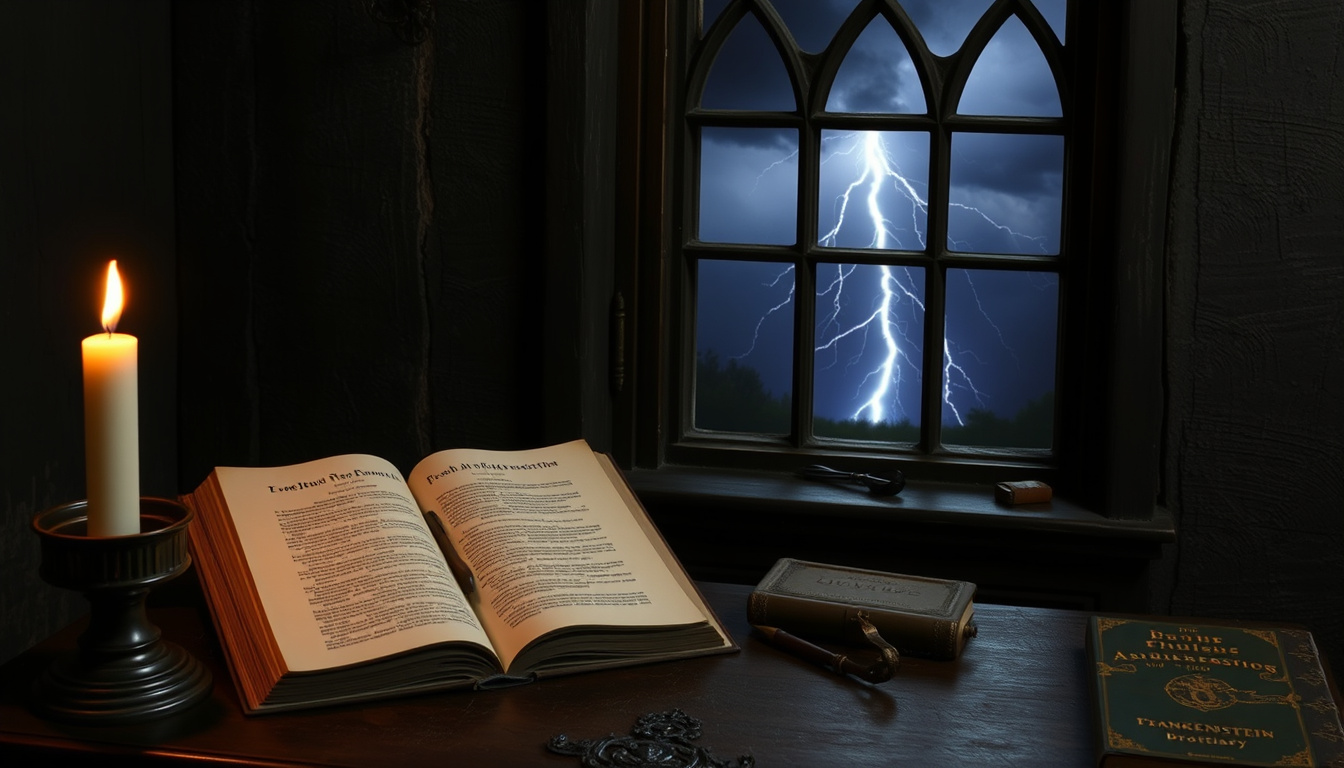
Few novelists have shaped a genre so completely that their name becomes synonymous with it. Mary Shelley did that with Frankenstein, a book she wrote before she turned twenty-one. But the woman behind the monster led a life marked by tragedy, resilience, and a series of personal scandals that still spark debate. This is the story of the mother of science fiction — the facts, the controversies, and the legacy.
Born: 30 August 1797, London, England ·
Died: 1 February 1851, London, England ·
Famous for: Frankenstein; or, The Modern Prometheus (1818) ·
Spouse: Percy Bysshe Shelley (married 1816–1822) ·
Children: 4 (only one survived to adulthood) ·
Parents: William Godwin and Mary Wollstonecraft
Quick snapshot
- Mary Shelley wrote Frankenstein (Britannica)
- She married Percy Shelley in 1816 (Britannica Kids)
- She had four children, only one survived (Poetry Foundation)
- Whether Mary Shelley had a female lover (Biography.com)
- The exact nature of her relationship with Percy after his infidelities (Biography.com)
- Whether the label “bisexual” accurately describes her identity (Biography.com)
- 1818: Frankenstein published (Wikipedia)
- 1822: Percy Shelley drowned (Britannica Kids)
- 1851: Mary died in London (Britannica Kids)
- Scholars continue to debate her sexuality and relationships (Los Angeles Public Library)
- New editions of her lesser-known novels are being published (Los Angeles Public Library)
Ten key facts, one pattern: Mary Shelley was a prolific writer who lived a life of extremes — fame, loss, and resilience.
The facts below summarize her biography in a compact format.
| Fact | Information |
|---|---|
| Full Name | Mary Wollstonecraft Shelley |
| Birth Date | 30 August 1797 |
| Death Date | 1 February 1851 |
| Nationality | English |
| Occupation | Novelist, short story writer, biographer, editor |
| Notable Work | Frankenstein; or, The Modern Prometheus |
| Literary Movement | Romanticism |
| Spouse | Percy Bysshe Shelley (m. 1816; died 1822) |
| Children | 4 (1 survived) |
| Parents | William Godwin, Mary Wollstonecraft |
What is Mary Shelley most famous for?
Mary Shelley is universally known as the author of Frankenstein; or, The Modern Prometheus, a novel she published in 1818 when she was only 20 years old (Britannica). The book is considered a foundational work of science fiction and has never been out of print.
What is Frankenstein about?
- A scientist, Victor Frankenstein, creates a sentient creature in a grotesque experiment.
- The novel explores themes of ambition, responsibility, and isolation.
- It was conceived during the summer of 1816 at Villa Diodati near Geneva, when Mary was 18 (Biography.com).
Mary Shelley wrote her masterpiece at an age when most modern college students are still choosing majors. That single book defined her public identity — and overshadowed everything else she wrote.
What other works did Mary Shelley write?
- She published several novels: Valperga (1823), The Last Man (1826), The Fortunes of Perkin Warbeck (1830), Lodore (1835), and Falkner (1837) (Britannica Kids).
- She also wrote travel narratives: History of a Six Weeks’ Tour (1817) and Rambles in Germany and Italy (1844) (Los Angeles Public Library).
- She edited and annotated her husband Percy Shelley’s poetry, preserving his literary legacy.
The pattern: Mary Shelley was a serious novelist and editor, but Frankenstein remains the gravitational center of her reputation. The trade-off: her later works are rarely read outside academic circles.
What was unusual about Mary Shelley’s life?
Mary Shelley was born into radicalism. Her mother, Mary Wollstonecraft, died days after childbirth in 1797 (University of Pennsylvania (Knarf project)). Her father, William Godwin, was a leading political philosopher. She grew up surrounded by the era’s most controversial thinkers.
Why did Mary Shelley elope with Percy Shelley?
- She met Percy Bysshe Shelley in spring 1814, when she was 16 (Britannica Kids).
- Percy was already married to Harriet Westbrook. The couple eloped to France in July 1814, taking Mary’s stepsister Claire Clairmont with them.
- They married in 1816 after Harriet’s suicide (Britannica Kids).
Did Mary Shelley have a female lover?
- Some historians suggest she may have had romantic attachments to women, though evidence is circumstantial.
- She formed intense friendships with women like Isabel Baxter and Jane Williams.
- No definitive letters or diaries confirm a same-sex relationship.
Does it matter if Mary Shelley was bisexual?
- The label “bisexual” is debated by scholars; it reflects modern identity categories applied to a historical figure.
- What is documented: Mary Shelley wrote passionately about female friendship and intellectual companionship.
- The question matters because it challenges the “tragic widow” narrative that has dominated her biography.
The debate over Mary Shelley’s sexuality is a modern lens. Readers should weigh the anachronism of labels against the documented intensity of her female relationships. The evidence is suggestive but not conclusive.
The implication: Mary Shelley’s personal life was unconventional by any era’s standards. The pattern of loss — her mother, three children, and her husband — shaped her as much as her radical upbringing.
Did Mary Shelley have an open relationship?
Percy Shelley’s letters indicate a non-monogamous understanding at times, though the term “open relationship” is anachronistic. Mary’s stepsister Claire Clairmont lived with the couple and had a relationship with Lord Byron (Biography.com).
What was Mary Shelley’s relationship with Percy Shelley like?
- Intellectual partners: they shared a passion for writing, politics, and philosophy.
- Emotionally turbulent: Percy’s affairs and financial instability strained the marriage.
- After Percy’s death, Mary devoted herself to editing his works, suggesting deep loyalty.
Did Mary Shelley have other lovers?
- There is no definitive evidence Mary herself had other sexual partners after Percy.
- Rumors circulated about a relationship with the American actor John Howard Payne, but nothing is confirmed.
- The concept of an “open relationship” is a modern framing; their arrangement was complex and not agreed upon in advance.
The catch: The evidence for an open relationship rests largely on Percy’s behavior and letters. Mary’s own desires remain opaque. The pattern is one of asymmetry — Percy had freedom, Mary bore the social consequences.
How many pregnancies did Mary Shelley have?
Mary became pregnant at least five times between 1815 and 1822. She gave birth to four children; only one, Percy Florence Shelley, survived to adulthood (Poetry Foundation).
What caused Mary Shelley’s miscarriages?
- Her first pregnancy in 1815 ended in a premature birth; the child died days later.
- She suffered a near-fatal hemorrhage after a miscarriage in 1816.
- The exact medical causes are unknown, but repeated pregnancies and inadequate medical care likely contributed.
Which of Mary Shelley’s children survived?
- Percy Florence Shelley (born 1819) was the only child to reach adulthood.
- Her daughter Clara (1817) died at age one; her son William (1816) died of malaria at age three.
- Another child, born prematurely in 1815, died shortly after birth.
Mary Shelley’s repeated pregnancies and losses took a permanent toll on her health. The physical cost of motherhood in the 19th century — combined with the emotional trauma — is a central but often overlooked story in her biography.
The trade-off: Mary Shelley’s literary output slowed after 1822, in part because of her health. The pattern of loss is not just a biographical detail; it shaped the themes of loneliness and isolation in her later novels.
Is Mary Shelley a ‘nepo baby’?
The term “nepo baby” — short for nepotism baby — is a modern label, but it raises a fair question. Mary Shelley was the daughter of two famous intellectuals: Mary Wollstonecraft, a philosopher and feminist pioneer, and William Godwin, a leading political philosopher and novelist.
Who were Mary Shelley’s parents?
- Mary Wollstonecraft wrote A Vindication of the Rights of Woman (1792), a foundational feminist text (Poetry Foundation).
- William Godwin was a prominent radical thinker and author of Political Justice.
- Mary grew up in a household that hosted the era’s leading intellectuals — Samuel Taylor Coleridge, William Wordsworth, Charles Lamb.
Did her parents’ fame help her career?
- Her father’s publishing connections helped her find a publisher for Frankenstein.
- But she achieved fame through her own work, not as a mere beneficiary of connections.
- She was a published author by age 20, which required talent, not just access.
The implication: Calling Mary Shelley a “nepo baby” reduces her achievement to a network effect. The reality is more nuanced: her parentage opened doors, but she walked through them on her own.
Why did Percy Shelley’s heart not burn?
After Percy Bysshe Shelley drowned in 1822, his body was cremated on the beach near Viareggio. According to accounts, his heart did not fully burn during the cremation — a detail that has fascinated readers for two centuries.
Did Mary Shelley keep Percy’s heart?
- The heart was reportedly retrieved from the pyre by Edward Trelawny, a friend of the Shelleys.
- Mary Shelley later kept the calcified heart in a silk pouch, and it was found among her belongings after her death.
- Accounts differ on its final resting place: some say it was buried with her son Percy Florence, others with her father William Godwin.
What is the story behind Shelley’s heart?
- The heart became a relic of Romantic devotion. Mary cherished it for nearly 30 years.
- Scientific explanation: the heart may have been calcified due to a disease (possibly tuberculosis of the pericardium), which would have made it resist combustion.
- The story underscores the intensity of Mary’s attachment to Percy — a bond that survived his death.
The heart that would not burn is a perfect metaphor for Mary Shelley’s own persistence. She outlived almost everyone she loved, yet she kept writing, editing, and preserving her husband’s legacy. The calcified heart is both a medical curiosity and a symbol of her resilience.
The takeaway: The heart anecdote is not just a gothic curiosity — it reveals how Mary Shelley constructed her identity as a widow and literary guardian. The pattern of preservation (editing Percy’s works, keeping his heart) formed her post-1822 life.
Timeline of Mary Shelley’s Life
- 30 Aug 1797 — Born in London to William Godwin and Mary Wollstonecraft (Britannica).
- 1814 — Eloped with Percy Bysshe Shelley to France; stepsister Claire Clairmont accompanied them (Britannica Kids).
- 1815 — First pregnancy ended in premature birth; child died days later.
- 1816 — Married Percy Shelley after his wife’s suicide. Writing of Frankenstein began at Villa Diodati with Byron (Biography.com).
- 1818 — Publication of Frankenstein; or, The Modern Prometheus (Wikipedia).
- 1819 — Birth of son Percy Florence, the only child to reach adulthood.
- 1822 — Percy Bysshe Shelley drowned in the Gulf of Spezia (Britannica Kids).
- 1823–1844 — Wrote and published several novels and travel books; edited Percy Shelley’s works.
- 1 Feb 1851 — Died in London at age 53, likely from a brain tumor (Britannica Kids).
Clarity: Confirmed vs. Unclear
Confirmed facts
- Mary Shelley wrote Frankenstein (Britannica).
- She married Percy Shelley in 1816 (Britannica Kids).
- She had four children, only one survived (Poetry Foundation).
- Percy’s heart did not burn during cremation (Biography.com).
What’s unclear
- Whether Mary Shelley had a female lover.
- The exact nature of her relationship with Percy after his infidelities.
- The specific medical cause of her miscarriages.
- Whether the label “bisexual” accurately describes her identity.
In their own words
“I saw the pale student of unhallowed arts kneeling beside the thing he had put together.”
— Mary Shelley, Introduction to the 1831 edition of Frankenstein (Britannica)
“My wife is a woman of very great genius.”
— Percy Bysshe Shelley, in a letter, 1817 (Poetry Foundation)
“She has a mind of considerable strength and discrimination.”
— William Godwin, on his daughter (University of Pennsylvania (Knarf project))
“Her life was a series of devastating losses, yet she persisted.”
— Fiona Sampson, biographer, In Search of Mary Shelley
Mary Shelley wrote her most famous work at 18, lost three children, buried her husband, and then spent three decades shaping his legacy. The pattern is not one of victimhood — it is one of stubborn authorship. For readers today, the choice is clear: treat her as a real, flawed, brilliant writer, not a tragic footnote to a Romantic poet. Or keep reading just Frankenstein — and miss the rest of the story.
shmoop.com, britannica.com, scribd.com, online.salempress.com, visit.bodleian.ox.ac.uk, xn--konominyt-k8a.dk
Frequently asked questions
What is Mary Shelley’s full name?
Mary Wollstonecraft Shelley.
How old was Mary Shelley when she wrote Frankenstein?
She was 18 when she began writing it, and 20 when it was published in 1818 (Biography.com).
Where did Mary Shelley get the idea for Frankenstein?
The idea came from a dream she had during the summer of 1816 at Villa Diodati, while staying with Lord Byron, Percy Shelley, and John Polidori (Britannica).
What does “The Modern Prometheus” mean?
The subtitle refers to the Greek myth of Prometheus, who stole fire from the gods and was punished. Victor Frankenstein, like Prometheus, defies natural limits and suffers the consequences.
Did Mary Shelley have any siblings?
She had a half-sister, Fanny Imlay, and a stepsister, Claire Clairmont (the daughter of William Godwin’s second wife).
What was Mary Shelley’s relationship with Lord Byron?
Byron was a close friend and neighbor during the summer of 1816. He encouraged the ghost-story contest that led to Frankenstein.
How did Mary Shelley die?
She died on 1 February 1851 in London, at age 53. The cause is believed to have been a brain tumor (Britannica Kids).
What is Mary Shelley’s legacy in science fiction?
She is widely credited as the mother of science fiction. Frankenstein established the template for the “mad scientist” story and raised ethical questions about creation and responsibility that remain relevant today (Biography.com).
Related reading
Related stories





Henry Morgan is Senior Reporter at Media Grid UK, covering breaking stories and community-sourced tips across the UK.