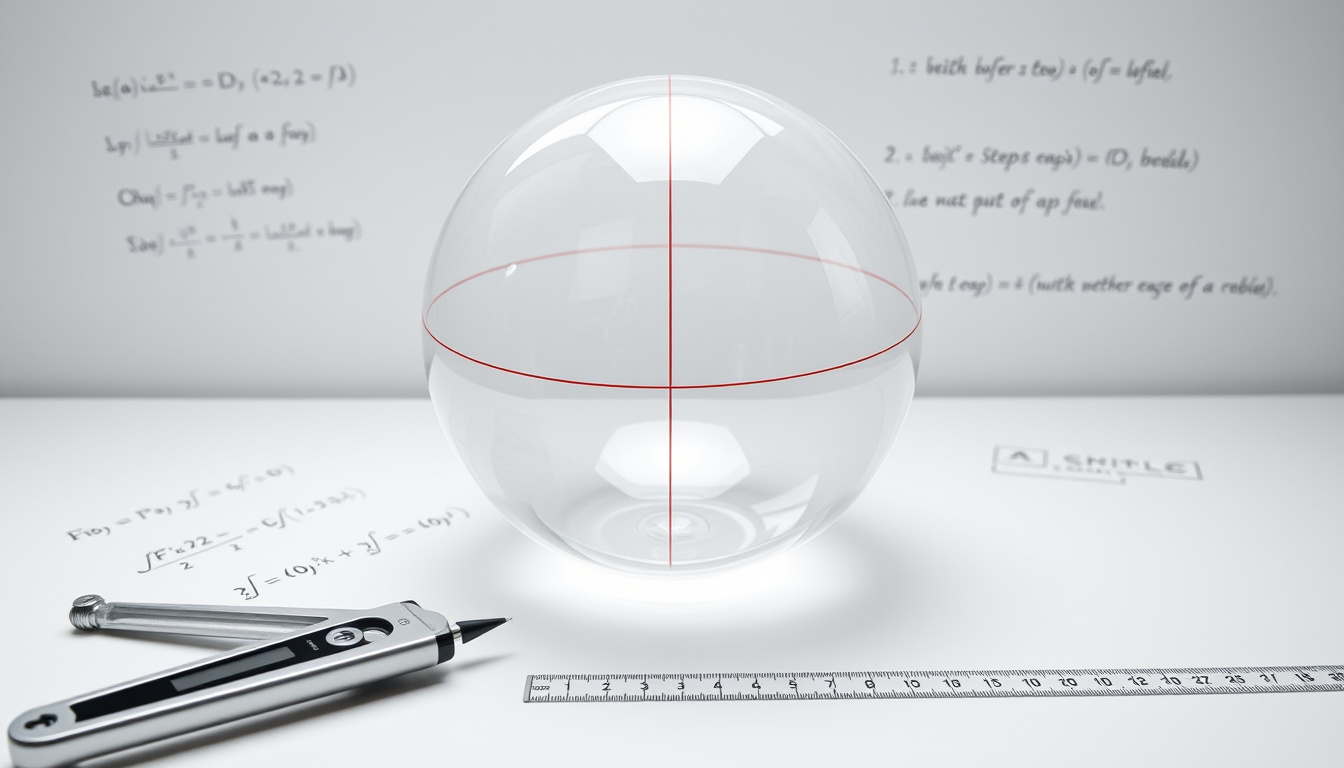

There’s a quiet satisfaction in knowing exactly how much space a sphere takes up — whether you’re calculating the volume of a basketball, a planet, or a soap bubble. The formula V = (4/3)πr³ has been used for over two thousand years since Archimedes.
Formula for sphere volume: V = (4/3)πr³ ·
π value: 3.1415926535… ·
Radius dependency: Cubic (r³) ·
Common unit: Cubic meters (m³)
Quick snapshot
- Sphere volume formula: V = (4/3)πr³ (BYJU’S (math education platform))
- Volume depends on cube of radius (BYJU’S)
- Archimedes first derived the formula ~250 BC (Wikipedia (open encyclopedia))
- c. 250 BCE – Archimedes calculates sphere volume (Wikipedia)
- 17th century – Calculus provides modern derivation (Cuemath (math tutorial resource))
- Present – Formula standard in geometry curricula (Wikipedia)
- Learn step-by-step calculation from radius or diameter (Cuemath)
- Explore unit conversions (litres, gallons) (Omni Calculator (online tool))
- Discover how the formula extends to higher-dimensional n-balls (Wikipedia)
Five key facts that define the volume of a sphere, one pattern: every entry traces back to the same relationship between radius and the constant π.
| Label | Value |
|---|---|
| Formula | V = (4/3)πr³ |
| Archimedes’ discovery | ~250 BCE |
| Volume relative to cylinder | 2/3 of circumscribed cylinder |
| π | 3.1415926535… |
| Common unit | Cubic meters (m³) |
What is the volume of the sphere formula?
What is the formula for the volume of a sphere?
- The standard formula is V = (4/3)πr³, where r is the radius of the sphere (BYJU’S (math education platform))
- Volume is always expressed in cubic units (e.g., cubic meters, cubic inches) because it measures three-dimensional space (BYJU’S)
- The constant π (pi) is approximately 3.1415926535 — an irrational number that never terminates (Wikipedia)
How to use the formula
- Identify the radius r (the distance from the center to any point on the surface). If you have the diameter, halve it (Cuemath (math tutorial resource))
- Cube the radius (r³), then multiply by (4/3)π (Cuemath)
- Attach the appropriate cubic units (e.g., m³, cm³, ft³) (BYJU’S)
What does each variable mean?
- V = volume of the sphere.
- r = radius of the sphere.
- π = mathematical constant, approximately 3.1416.
- The exponent 3 indicates the cube of the radius, reflecting the three-dimensional nature of volume (BYJU’S)
The cubic dependency means doubling the radius multiplies the volume by 8 — a small change in size causes a massive change in capacity. For educators and students, this explains why even tiny measurement errors in radius lead to big volume errors.
The implication: the formula’s structure — (4/3)πr³ — is not arbitrary; it arises directly from the geometry of a sphere and its relationship to a cylinder.
Archimedes showed that the sphere’s volume is 2/3 of its circumscribed cylinder, a ratio that underpins the modern formula.
Why is 4:3 used in the volume of a sphere?
How was the formula derived?
- The derivation uses the comparison between a sphere and its circumscribed cylinder. Archimedes showed that the sphere’s volume is 2/3 of the cylinder’s volume (Cuemath)
- Since the cylinder’s volume is πr²h and h = 2r for a circumscribed cylinder, the sphere’s volume becomes (2/3)πr²(2r) = (4/3)πr³ (Cuemath)
- Modern calculus derives the same result by integrating cross-sectional areas of the sphere (Wikipedia)
What is the connection to a cylinder?
- A sphere fits perfectly inside a cylinder whose height equals its diameter. The sphere takes up exactly 2/3 of the cylinder’s total volume (Cuemath)
- This ratio — 2:3 — is a geometric constant that appears in no other simple solid (Wikipedia)
Why not 4/3 for other shapes?
- The fraction 4/3 arises specifically from the sphere’s uniform curvature in three dimensions. For a cube, the volume formula (s³) has no fractional constant. For a cone, it’s 1/3πr²h (Wikipedia)
- The 4/3 factor is a direct consequence of integrating over a spherical shape — it’s the same factor that appears in the volume of an n-ball in odd dimensions (⋯).
The pattern: the 4/3 constant isn’t arbitrary — it’s the signature of a sphere’s perfect symmetry in ordinary 3D space.
The 4/3 constant emerges from the unique relationship between a sphere and its circumscribed cylinder, a ratio first demonstrated by Archimedes.
How did Archimedes calculate the volume of a sphere?
What method did Archimedes use?
- Around 250 BCE, Archimedes used a mechanical method — conceptually balancing the sphere against a cone and cylinder on a lever — to discover the relationship (Wikipedia)
- He also employed water displacement to verify the volume physically (Wikipedia)
What is the relationship with a cylinder?
- Archimedes proved that the volume of a sphere is exactly two-thirds the volume of its circumscribed cylinder (Cuemath)
- He considered this his greatest achievement — he requested a sphere and cylinder be engraved on his tomb (Wikipedia)
How does his method relate to modern formula?
- His mechanical method produced the same result as today’s calculus derivation. From the cylinder volume πr²h (with h=2r) multiplied by 2/3, we get V = (4/3)πr³ (Cuemath)
- Modern integration confirms Archimedes’s insight: the sum of infinitesimally thin circular disks from bottom to top yields exactly the same formula.
“Sphere’s volume : cylinder’s volume = 2 : 3” — Archimedes, On the Sphere and Cylinder (translated).
Wikipedia (open encyclopedia)
“Only the radius is needed to compute sphere volume using V=4/3 π r³.” — Middle School Math Video tutorial.
The catch: Archimedes’ original proof manuscripts are lost; modern reconstructions rely on later commentaries — so part of the method remains conjectural.
Archimedes’ mechanical method and water displacement established the sphere’s volume as 2/3 of the cylinder’s, a result confirmed by modern calculus.
What is the easiest way to find the volume of a sphere?
Step-by-step calculation
- Measure the radius (or diameter and halve it).
- Cube the radius (multiply it by itself three times).
- Multiply by (4/3)π — use 3.14159 for π or a calculator π button.
- Label the result with cubic units (Cuemath)
Using radius
- Example: radius r = 10 inches. V = (4/3)π(10)³ = (4/3)π × 1000 ≈ 4189 cubic inches (Geometry Video Tutorial (YouTube))
- Example: radius r = 2. V = (4/3)π(2)³ = (4/3)π × 8 ≈ 33.5 cubic units (Omni Calculator (online tool))
Using diameter
- If only the diameter d is known, use the alternative formula V = (πd³)/6 (Cuemath)
- Alternatively, convert diameter to radius (r = d/2) and use the standard formula (Middle School Math Video (YouTube))
Using a calculator
- Online sphere volume calculators automate the process — just enter the radius or diameter (Omni Calculator)
- They also handle unit conversions and display the result in multiple units.
For students and professionals alike, the single most common error is using the diameter instead of the radius. Divide by 2 first — always. A radius mistake makes the volume wrong by a factor of 8.
What this means: even if you use a calculator, understanding the cubic relationship helps you spot impossible results — like a volume larger than the cylinder containing the sphere.
To avoid the most common error, always divide the diameter by 2 before plugging into the formula; a small mistake here scales volume by a factor of 8.
How to calculate the volume of a sphere using diameter?
Formula with diameter
- V = (πd³)/6, where d is the diameter of the sphere (Cuemath)
- This formula is derived by substituting r = d/2 into V = (4/3)πr³ (Omni Calculator)
Example calculation
- Example: diameter d = 18 units → radius r = 9 units. V = (4/3)π(9)³ = (4/3)π × 729 ≈ 3053.6 cubic units (Middle School Math Video (YouTube))
- Using the diameter formula directly: V = π(18)³/6 = π × 5832/6 = π × 972 ≈ 3053.6 cubic units — same result (Cuemath)
Converting diameter to radius
- Rule: r = d/2. Never plug the diameter directly into the radius formula — that gives a volume eight times too large (Middle School Math Video (YouTube))
- Quick check: a sphere of diameter 2 has radius 1 and volume ≈ 4.19; using d=2 incorrectly in the radius formula gives volume ≈ 33.5 — a red flag.
The trade-off: using the diameter formula saves one arithmetic step, but the radius formula is more widely taught and less prone to unit confusion.
The diameter formula V = (πd³)/6 produces the same result as the radius formula after halving, but using the wrong input multiplies volume by 8.
Step-by-Step Calculation Process
- Determine the radius r (measure or derive from diameter/circumference).
- Compute r³ (r × r × r).
- Multiply by (4/3)π. If using π ≈ 3.14159, (4/3)π ≈ 4.18879.
- Assign cubic units (e.g., cm³, m³, in³).
- Optionally, use an online sphere volume calculator to verify (Omni Calculator)
If you only have circumference c, first find radius via r = c / (2π), then apply the volume formula. The extra conversion step is a common source of error for geometry students.
For DIY makers and engineers: these steps work for any sphere — from ball bearings to weather balloons. A small measurement error in radius multiplies by three orders of magnitude in the final volume, so precision matters.
What’s Confirmed and What’s Unclear
Confirmed facts
- The sphere volume formula V = (4/3)πr³ is mathematically proven (Wikipedia)
- Archimedes’ discovery is historically documented (~250 BCE) (Wikipedia)
- Sphere volume equals 2/3 of its circumscribed cylinder (Cuemath)
What’s unclear
- The exact reasoning Archimedes used for his mechanical method is partly reconstructed from later commentaries (Wikipedia)
- Behavior of volumes in higher dimensions (n>5) is less intuitive and counterintuitive to many (Wikipedia)
Quotes from the Experts
“Sphere’s volume : cylinder’s volume = 2 : 3” — Archimedes, On the Sphere and Cylinder (translated).
Wikipedia (open encyclopedia)
“Only the radius is needed to compute sphere volume using V=4/3 π r³.” — Middle School Math Video tutorial.
Middle School Math Video (YouTube)
From ancient Greece to the modern classroom, the same formula holds — and continues to surprise new learners.
Summary
The formula V = (4/3)πr³ is one of geometry’s most elegant results, linking a sphere’s volume to the cube of its radius through a constant that has held for over two millennia. For students encountering it for the first time, the key is remembering the cubic relationship and the division by 2 when starting from diameter. For educators and researchers, the historical path — from Archimedes’ water displacement to integration — offers a rich proof that the formula is not arbitrary but a necessary consequence of spherical symmetry. The consequence: whether you’re a high school student calculating the volume of a soccer ball or an engineer sizing a spherical tank, the same simple formula delivers an answer — provided you get the radius right.
Related reading: Volume of Sphere – BYJU’S
Frequently asked questions
How to find the volume of a sphere with a given circumference?
First compute the radius from circumference: r = c / (2π). Then plug r into the standard formula V = (4/3)πr³ (Omni Calculator)
What is the volume of a sphere with radius 5 cm?
V = (4/3)π(5 cm)³ = (4/3)π × 125 cm³ ≈ 523.6 cm³ (BYJU’S)
How is sphere volume formula derived using calculus?
By integrating cross-sectional disks: area of a cross-section at height h is π(r² − h²), integrated from −r to r yields (4/3)πr³ (Wikipedia)
What is the volume of a hemisphere?
A hemisphere is exactly half a sphere: V = (2/3)πr³. For example, radius 10 yields V ≈ 2094 cubic units (Cuemath)
How do you remember the sphere volume formula?
Common mnemonics: “4/3 pi r-cubed” — think of it as the pizza (pi) times the cube of the radius, with 4/3 as the cheese-to-crust ratio.
What is the difference between sphere volume and surface area?
Volume measures three-dimensional space (V = 4/3πr³), while surface area measures the outer surface (A = 4πr²). Surface area is the derivative of volume with respect to radius (BYJU’S)
Can the sphere volume formula be used for an ellipsoid?
No. An ellipsoid has three different radii, and its volume formula is V = (4/3)πabc, where a, b, c are semi-axes (Wikipedia)
Related stories





Rebecca Haines is Managing Editor at Media Grid UK, running the daily news list, commissioning and headline review.