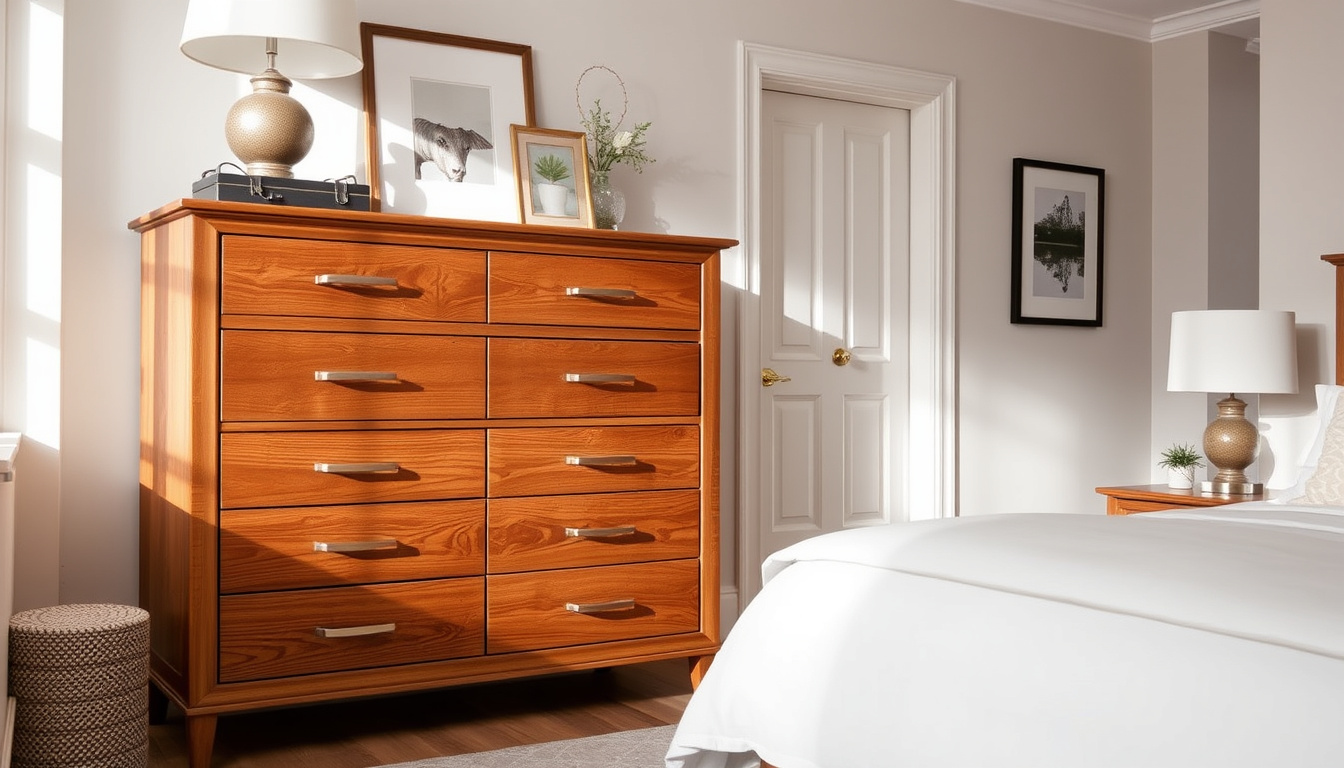
A chest of drawers can quietly define how a room feels. It’s the piece that holds everything from socks to keepsakes, yet choosing one often falls somewhere between impulse buy and major decision. This guide walks you through types, sizes, placement, and buying tips so you can match the right chest to your space.
Average number of drawers: 3 to 9 · Typical height: 36–48 inches · Common material: Wood (oak, pine, mahogany) · Average price range: €100–€500 · Standard width: 30–48 inches
Quick snapshot
- Chest of drawers remain a popular storage choice across bedrooms, living rooms, and home offices (Elystra Living (UK furniture retailer))
- Multiple styles exist: highboy, lowboy, tallboy, bachelor chest, and upright chest (Joss & Main (home décor retailer))
- Exact market share of chest of drawers versus other storage solutions (ManoMano (home improvement retailer))
- Long-term trend impact of minimalist living on chest-of-drawers demand (ManoMano (home improvement retailer))
- Dovetail joints indicate better quality drawer construction (ManoMano (home improvement retailer))
- Styles have evolved from ornate Victorian highboys to clean-lined modern units (Joss & Main (home décor retailer))
- Expect more multi-functional designs that combine chest storage with media console features
Here is a quick overview of typical chest of drawers dimensions and specifications based on retailer data.
| Attribute | Typical value |
|---|---|
| Average number of drawers | 3 to 9 |
| Typical height | 36–48 inches |
| Common material | Wood (oak, pine, mahogany) |
| Average price range | €100–€500 |
| Standard depth | 15–20 inches |
| Standard width | 30–48 inches |
Do People Still Use Chest of Drawers?
Modern relevance of chest of drawers
- Chest of drawers remain a popular choice for extra storage in bedrooms, living rooms, and home offices (Elystra Living (UK furniture retailer))
- Many models now incorporate sleek, minimalist designs that fit contemporary interiors (Joss & Main (home décor retailer))
Yes — chest of drawers haven’t gone anywhere. While built-in wardrobes and modular storage systems have gained ground, the standalone chest still serves a distinct purpose: flexible, movable storage that doesn’t require construction work.
Chest of drawers vs. built-in wardrobes
Built-in wardrobes offer seamless integration but come with higher installation costs and a permanent footprint. A chest of drawers, by contrast, can be repositioned when you rearrange a room or move homes. For renters especially, that freedom matters.
What this means: a chest of drawers fills the gap between closet storage and small-space flexibility — two things built-ins can’t easily replace.
For anyone living in a rented flat, a chest of drawers is one of the few storage pieces you can take with you. Landlords rarely supply them, and built-ins aren’t an option.
The implication: for most households, a chest of drawers remains a practical, flexible storage solution that adapts to changing needs.
What Are the Different Names for a Chest of Drawers?
Chest of drawers vs. dresser vs. bureau
- A chest of drawers is also called a dresser, bureau, or commode (Joss & Main (home décor retailer))
- A dresser typically includes a mirror, while a chest of drawers usually stands alone (Elystra Living (UK furniture retailer))
- A bureau combines a writing desk with drawers below (ManoMano (home improvement retailer))
What is a fancy name for a chest of drawers?
“Highboy” and “lowboy” are the classic fancy terms — a highboy is a tall chest on legs, while a lowboy is a shorter version often paired with a highboy as a set. “Tallboy” and “bachelor chest” also carry a more refined tone, depending on the design era.
What is a Dutch dresser?
A Dutch dresser is a specific antique style with two solid doors below the drawers, often featuring a plate rack on top. It originated in the Netherlands in the 17th century and remains a collector’s piece today (Joss & Main (home décor retailer)).
The pattern: most people call it a dresser, but the name matters when searching for specific styles like tallboy (narrow and tall) or lowboy (low and wide). Getting the terminology right means finding the right dimensions.
What Are the Best Alternatives to a Chest of Drawers?
Alternative storage furniture options
- Wardrobe / armoire: good for hanging clothes but takes up more floor space (Elystra Living (UK furniture retailer))
- Storage bench: compact but limited drawer capacity (ManoMano (home improvement retailer))
- Drawer organizers / modular cubes: customizable but don’t offer a unified look (ManoMano (home improvement retailer))
Three alternatives, one trade-off: wardrobes store hanging items better, chests win on drawer organization.
| Alternative | Storage capacity | Typical price range | Best for |
|---|---|---|---|
| Chest of drawers | 3–9 drawers, moderate volume | €100–€500 | Folded clothes, small items |
| Wardrobe / armoire | Hanging rod + 1-2 shelves | €200–€800 | Hanging clothes, bulky items |
| Storage bench | 1–2 deep drawers or lid | €50–€300 | Entryway or small bedrooms |
| Modular cube system | Customizable bins | €30–€150 per unit | Flexible layouts |
The catch: none of these alternatives match the chest of drawers’ combination of vertical storage and surface space for a lamp or decor. That double function — drawer space plus a flat top — is hard to beat.
Where Should You Place a Chest of Drawers?
Ideal room locations
- Best place is a bedroom near the closet or dressing area (Elystra Living (UK furniture retailer))
- Also works in living rooms as a media console or entryway organizer (Joss & Main (home décor retailer))
Placement tips for small spaces
- Leave roughly 60 cm of clear floor in front so drawers can open fully (Elystra Living (UK furniture retailer))
- A chest used as a bedside surface works best at 75–90 cm tall (Elystra Living (UK furniture retailer))
- Narrow tallboys (40–60 cm wide) suit tight corners (MeetFelix (UK furniture buying guide))
Feng shui considerations
Feng shui principles recommend placing a chest of drawers in the “command position” — visible from the bed but not blocking the doorway. Avoid positioning it directly opposite a window, as that can create a feeling of imbalance. The goal: keep energy flowing freely while the chest anchors the room.
Why this matters: the difference between a well-placed chest and a poorly positioned one is the difference between a room that feels organised and one that feels cluttered. Measure twice, buy once.
Placing a chest in a hallway adds storage but reduces walkway space. In a small flat, that 60 cm clearance requirement can mean the difference between a functional room and a cramped one.
The implication: placement is as important as the chest itself — the right location makes the piece functional, not just decorative.
What Should You Look for When Buying a Chest of Drawers?
- Measure your space — record width, depth, and height before purchasing to ensure the chest fits the intended location.
- Determine drawer count — 3 to 9 drawers depending on what you need to store, from socks to bedding.
- Choose material — solid wood (oak, pine, mahogany) outperforms MDF or veneer in longevity.
- Check construction — dovetail joints and ball-bearing glides indicate a piece built to last.
- Set a budget — €100–€500 is typical; mid-range models (€150–€350) offer the best balance of quality and cost.
Key factors: size, material, drawer construction
- Measure space for width, depth, and height before purchasing (ManoMano (home improvement retailer))
- Look for solid wood construction and dovetail joints (Elystra Living (UK furniture retailer))
- Check drawer glides — ball-bearing glides are best (ManoMano (home improvement retailer))
- Consider number of drawers and interior depth (Elystra Living (UK furniture retailer))
How to assess quality and durability
Solid wood — oak, pine, or mahogany — typically outperforms MDF or veneer in longevity. Dovetail joints at the drawer corners mean the piece was built to last, not glued together. Ball-bearing glides allow smooth, full-extension drawer movement even under load (ManoMano (home improvement retailer)).
Price considerations and budget tips
- Average price range: €100–€500 (ManoMano (home improvement retailer))
- Budget models (under €150): often MDF or veneer, plastic glides
- Mid-range (€150–€350): solid wood front, metal glides, better joinery
- Premium (€350+): solid wood throughout, dovetail joints, full-extension ball-bearing glides
Six key factors, one bottom line: size first (measure your space), then construction (dovetail + ball-bearing), then material (solid wood beats MDF). Skip the fancy hardware if the build quality isn’t there.
A cheap chest with plastic glides will sag after two years of daily use. For a piece that’s meant to last, invest in mid-range or better — the difference in durability is 5–10 years of extra service.
The bottom line: a well-chosen chest of drawers pays for itself in daily use and longevity.
Upsides
- Flexible placement — can be moved between rooms
- Combines drawer storage with a flat surface for decor
- Wide range of styles and price points
- Good for folded clothes, socks, accessories, and more
Downsides
- Requires 60 cm clearance in front for drawers to open
- Can be heavy and difficult to move once assembled
- Limited capacity for hanging clothes
- Cheap models may warp or stick within a few years
venturainteriors.com, alibaba.com, stylenest.co.uk, belleze.com, mattressmiracle.ca, ojcommerce.com, presseton.de
For anyone looking to purchase a new storage piece, our complete buying guide walks through everything from sizing to materials and placement tips.
Frequently asked questions
What is the standard height of a chest of drawers?
Standard height ranges from 36 to 48 inches (roughly 90–120 cm). Tallboys can reach up to 54 inches (137 cm), while lowboys are around 30–36 inches (75–90 cm) (Of Standard (furniture dimensions resource)).
How do I clean and maintain a chest of drawers?
Dust with a soft cloth weekly. Use a mild wood cleaner for solid-wood pieces — avoid harsh chemicals. Tighten loose screws on drawer glides every six months to prevent sagging.
Can a chest of drawers be used as a TV stand?
Yes, many wide six-drawer chests work well as media consoles. Ensure the top surface is wide enough for the TV base and that ventilation exists for electronics. Consider a chest with cable management cutouts.
What is the difference between a chest of drawers and a dresser?
A dresser typically includes a mirror and may be wider; a chest of drawers usually stands alone without a mirror. In practice, the terms are often used interchangeably (Joss & Main (home décor retailer)).
Are chest of drawers easy to assemble?
Most flat-pack chests come with clear instructions and require basic tools. Solid wood, pre-assembled models are easier but more expensive. Allow 30–60 minutes for assembly of a standard 4-drawer unit.
How much weight can a chest of drawers hold?
A well-built chest of drawers can hold 30–50 kg distributed across all drawers. Individual drawer limits vary — check the manufacturer’s specifications. Overloading can cause drawer glides to fail.
What is the standard depth of a chest of drawers?
Standard depth ranges from 16 to 20 inches (40–50 cm). Shallow chests (15 inches / 38 cm) fit narrow hallways, while deeper models (22–24 inches / 55–60 cm) offer more storage (Elystra Living (UK furniture retailer)).
For those furnishing a UK or Irish home, the practical advice is simple: buy from a reputable retailer, check the dimensions against your room plan, and prioritise construction quality over price. A chest of drawers is not a disposable item — it’s a long-term investment in daily convenience. For more furniture selection guidance, see our Bar Stools Ireland: Choosing Between Bar and Counter Stools guide.
Related stories





Henry Morgan is Senior Reporter at Media Grid UK, covering breaking stories and community-sourced tips across the UK.