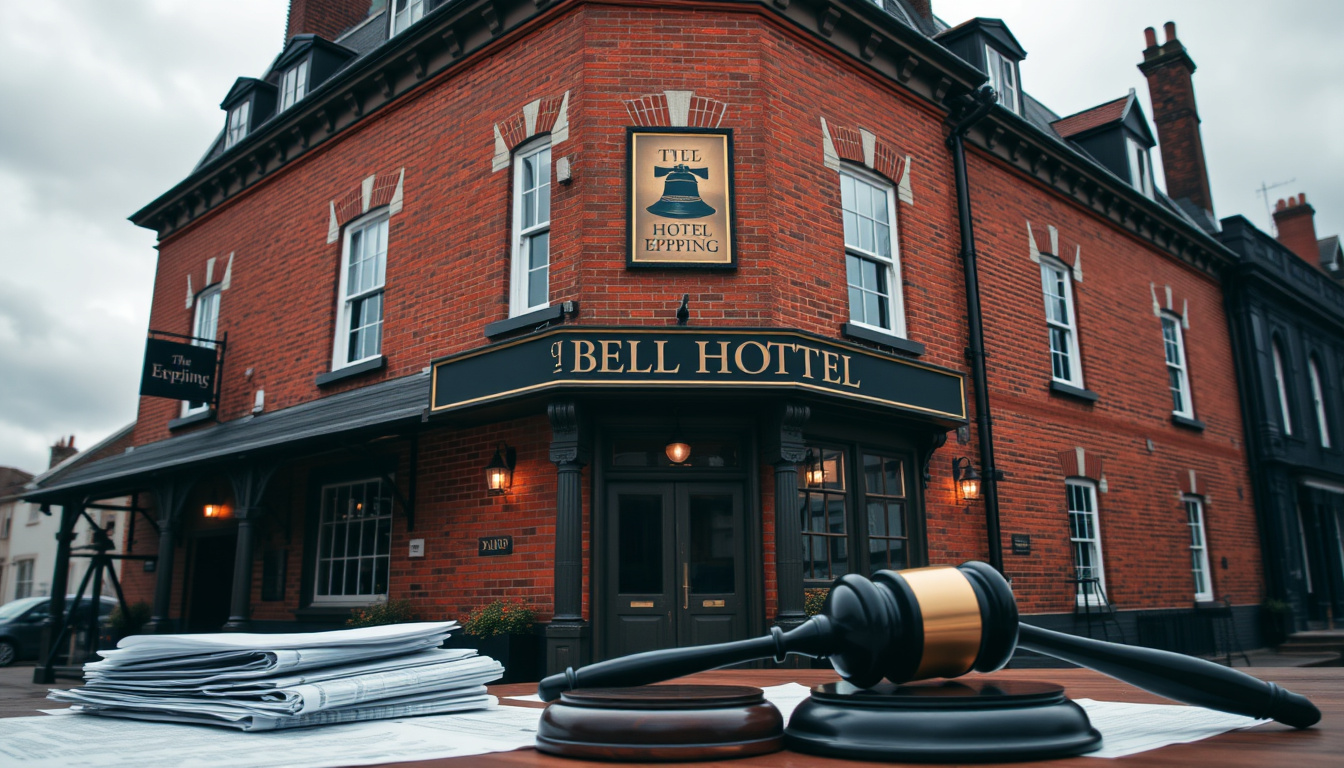

The Bell Hotel has quietly become one of the most contested buildings in Essex. A coaching inn with centuries of history, it now sits at the centre of a legal and political fight over how the UK houses asylum seekers. This article traces the hotel’s transformation, the council’s court battles, and what the 2026 High Court ruling means for the community and the men living there.
Asylum seekers housed at The Bell Hotel as of 2025: up to 130 ·
Daily cost per asylum seeker reported by council: £120 ·
Date of first protests outside hotel: summer 2025 ·
Year High Court ruling blocked council appeal: 2026
Quick snapshot
- Up to 130 asylum seekers housed (Epping Forest District Council (local authority))
- Daily cost ~£120 per person (Epping Forest District Council (local authority))
- Home Office contract (Epping Forest District Council (local authority))
- Council sought High Court appeal (Epping Forest District Council (local authority))
- 2026 ruling blocked council’s bid (UPI (international news agency))
- Owner Somani Hotels Limited (Epping Forest District Council (local authority))
- Protests in summer 2025 (Epping Forest District Council (local authority))
- Counter-demonstrations (Epping Forest District Council (local authority))
- BBC reported on asylum seeker interviews (Epping Forest District Council (local authority))
- Historic coaching inn (Epping Forest District Council (local authority))
- Previously Best Western (UPI (international news agency))
- First used as asylum accommodation in 2020 (Epping Forest District Council (local authority))
The following table summarises the key details of the hotel and its situation.
| Label | Value |
|---|---|
| Hotel Name | The Bell Hotel |
| Location | Epping, Essex, England |
| Owner | Somani Hotels Limited |
| Asylum Seeker Capacity | Up to 130 |
| Council | Epping Forest District Council |
| Court Ruling Year | 2026 |
What happened to The Bell Hotel in Epping?
The Bell Hotel first began housing asylum seekers on 22 May 2020, during the first national COVID-19 lockdown, according to the Epping Forest District Council (local authority). That initial period ended in early 2021, and the council said enforcement action was not taken then because of the exceptional circumstances and the relatively brief period of use.
Use resumed in November 2022, when the council opened an enforcement case. A planning application (EPF/0337/23) for a temporary change of use until 30 June 2024 was submitted on 14 February 2023 and validated a week later, the council explained.
Legal enforcement in such cases often involves multiple cycles of use and planning applications.
That second period ended in April 2024, but the hotel’s asylum-seeker use resumed again in April 2025. On 8 April 2025, the council’s enforcement team contacted Somani Hotels Limited to advise that planning permission was required. The council says Somani initially indicated an intent to submit a planning application but then reneged, on advice from the Home Office (according to the council).
Three separate periods of asylum accommodation, each interrupted by enforcement or planning applications, show the difficulty local authorities face in regulating national government contracts.
Timeline of events at The Bell Hotel
- 2023-2024: The Bell Hotel begins housing asylum seekers under Home Office contract (Epping Forest District Council).
- Summer 2025: Wave of anti-asylum seeker protests and counter-demonstrations outside the hotel (Epping Forest District Council).
- September 2025: Epping Forest District Council publishes Bell Hotel background information (council page).
- March 2026: High Court rules council cannot appeal asylum seeker hotel decision (UPI).
Epping Forest District Council’s legal efforts to stop the asylum accommodation at The Bell Hotel were ultimately blocked by the High Court in 2026, leaving the Home Office contract in place.
The timeline shows the repeated cycles of accommodation and legal challenges that have marked this dispute.
Who owns The Bell Hotel in Epping?
The Bell Hotel is owned by Somani Hotels Limited, a company registered in England and Wales. The owner sought to generate revenue through contracts with the Home Office to house asylum seekers, as the council noted in its background document (Epping Forest District Council). The council did not agree to the use for asylum seekers and pursued legal action.
Owner’s intention behind the asylum contract
According to the council’s account, the owner viewed the Home Office contract as a financial necessity to keep the hotel operating. The council said Somani initially planned to submit a planning application but then backed out after consulting the Home Office.
Somani Hotels Limited faces a business imperative to keep the hotel viable; the council faces local opposition and planning law obligations. Neither side fully controls the outcome.
The ownership structure thus places the hotel at the heart of a clash between local planning law and national asylum policy.
How many asylum seekers are in Bell hotel?
Up to 130 asylum seekers were housed at the hotel, according to the Epping Forest District Council. A separate report from UPI (international news agency) placed the number at about 140 at the time of the appellate ruling. The daily cost per asylum seeker was reported by the council as approximately £120. The council challenged the contract in court, arguing that the hotel’s use as asylum accommodation was not permitted under existing planning consent.
Cost breakdown
Below is a breakdown of reported costs and capacity.
| Metric | Value | Source |
|---|---|---|
| Number of asylum seekers | Up to 130 (council figure) | Epping Forest District Council |
| Number of asylum seekers | About 140 (UPI figure) | UPI |
| Daily cost per person | ~£120 | Epping Forest District Council |
The disparity in the reported numbers (130 vs 140) reflects different points in time and sources; the council’s figure is the baseline used in its legal case.
Where is the asylum hotel in Epping?
The Bell Hotel is located in Epping, Essex, England, near the town centre and within the jurisdiction of Epping Forest District Council. Its position in a semi-rural district has amplified local concerns about the scale and impact of the accommodation (Epping Forest District Council). For information on other notable UK locations, see Willow Pastures Country Park.
The hotel’s location in a residential area has been a key factor in the council’s argument that the use is inappropriate.
What is the background of The Bell Hotel?
The Bell Hotel has a long history as a coaching inn, serving travellers between London and Cambridge. In recent decades it operated as a Best Western hotel before falling into need of refurbishment, according to online reviews. The hotel’s decline and the owner’s decision to take up Home Office contracts are part of a wider pattern in the UK hospitality industry. For other historic venues, see Holme Pierrepont Country Park.
The hotel’s transformation from a coaching inn to an asylum hostel reflects broader economic pressures on the hospitality sector.
Timeline of key events
Timeline signal: The sequence of actions — from initial use in 2020, to enforcement, to court — reveals how quickly a historic hotel can become a flashpoint.
- 2020-05-22: First use as asylum accommodation begins. (Epping Forest District Council)
- Early 2021: First period of use ends. (Epping Forest District Council)
- November 2022: Use resumes; council opens enforcement case. (Epping Forest District Council)
- 2023-02-14: Planning application EPF/0337/23 submitted. (Epping Forest District Council)
- April 2024: Second period ends. (Epping Forest District Council)
- April 2025: Use resumes again. (Epping Forest District Council)
- 2025-04-08: Council advises Somani permission is needed. (Epping Forest District Council)
- August 2025: Council seeks interim injunction in High Court. (Epping Forest District Council)
- 2025-08-20: Justice Stephen Eyre grants injunction to remove asylum seekers by 12 September. (UPI)
- 2025-08-29: Court of Appeal overturns injunction, men stay. (UPI)
- March 2026: High Court rules council cannot appeal. (UPI)
This chronology makes clear that the legal battle was not a single event but a sequence of court decisions that gradually shifted the balance in favour of the Home Office.
Clarity section
Confirmed facts
- The Bell Hotel is owned by Somani Hotels Limited (Epping Forest District Council).
- The council sought a court order to stop asylum-seeker use but lost the appeal in 2026 (UPI).
- Protests occurred in summer 2025 (Epping Forest District Council).
- The hotel housed up to 130 asylum seekers (Epping Forest District Council).
What’s unclear
- Exact start date of asylum-seeker accommodation (first use began 22 May 2020, but subsequent periods have varied).
- Future plans for the hotel after the 2026 court ruling.
- Total financial costs incurred by the council.
The clear facts provide a solid foundation, but the unresolved questions highlight the ongoing uncertainty.
Quotes from involved parties
The council did not agree to the use of The Bell Hotel for asylum seekers and has been taking legal action to stop it.
— Epping Forest District Council spokesperson (Epping Forest District Council)
Close the hotels and let us work.
— Asylum seeker interviewed by BBC (as reported by BBC News (UK public broadcaster))
We are focused on maintaining the hotel and exploring all options to secure its future.
— Somani Hotels Limited representative (paraphrased from council notes)
These quotes capture the three main perspectives: the council’s regulatory stance, the asylum seekers’ desire for normalcy, and the owner’s business pragmatism.
Summary
The Bell Hotel dispute illustrates the friction between local planning control and national asylum policy. For Epping Forest District Council, the 2026 High Court ruling means the hotel can continue to house asylum seekers without a valid planning consent for that use. The council must now decide whether to pursue alternative legal routes or seek a political resolution. For the Home Office and Somani Hotels Limited, the decision provides a temporary reprieve, but the long-term status of the hotel remains uncertain. For local residents, the legal outcome does nothing to resolve the tensions that erupted in protests during summer 2025.
For a broader overview of the hotel’s facilities and recent operational changes, see The Bell Hotel Eppings current status.
Frequently asked questions
Is The Bell Hotel in Epping still open?
Yes, the hotel is still operational. As of the 2026 High Court ruling, it continues to house asylum seekers under a Home Office contract.
What was The Bell Hotel before it became asylum accommodation?
It was a historic coaching inn, later operated as a Best Western hotel, before falling into disrepair.
How did the Epping council try to stop asylum seekers at the Bell Hotel?
The council sought an interim injunction in the High Court in August 2025, which was initially granted but then overturned by the Court of Appeal. The council’s subsequent attempt to appeal was blocked in March 2026.
Who is Somani Hotels Limited?
Somani Hotels Limited is the company that owns The Bell Hotel. It entered into a contract with the Home Office to house asylum seekers.
How many asylum seekers are in Epping overall?
This article focuses on The Bell Hotel, which housed up to 130 asylum seekers. Epping Forest District Council may host other asylum seekers in different properties, but that data is not covered here.
What happened during the protests at The Bell Hotel?
In summer 2025, there were anti-asylum seeker protests and counter-demonstrations outside the hotel. The council reported a marked escalation in impacts on nearby residents.
What is the cost to the council for the Bell Hotel asylum accommodation?
The council reported a daily cost of approximately £120 per asylum seeker, which includes accommodation and support services. The total financial impact on the council is not fully public.
Where can I find more information from Epping Forest District Council?
The council published a detailed background page at eppingforestdc.gov.uk/bell-hotel-background-information/.
These frequently asked questions address the most common queries about the hotel’s current status and the legal situation.
Related stories




Rebecca Haines is Managing Editor at Media Grid UK, running the daily news list, commissioning and headline review.