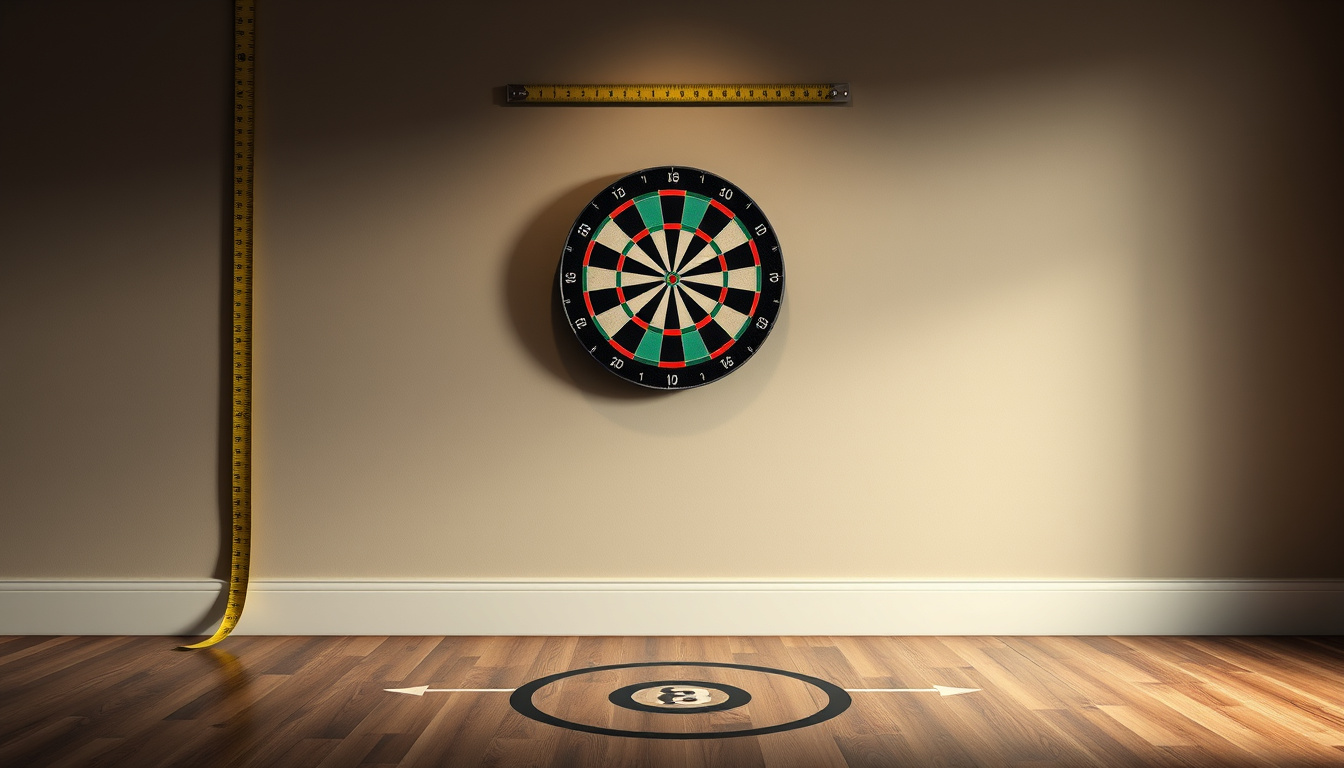
Setting up a dartboard should be simple — grab a tape measure, mark a line, start throwing. But a surprising number of home setups get the darts distance wrong, often by confusing two key measurements. This guide walks you through the exact official distances for steel tip and soft tip boards, the correct way to measure from the board face (not the wall), and how to check your setup in under 30 seconds.
Steel tip distance: 2.37 m (7 ft 9¼ in) ·
Soft tip distance: 2.44 m (8 ft) ·
Bullseye height: 1.73 m (5 ft 8 in) ·
Diagonal check: 2.93 m (9 ft 7½ in) ·
Common mistake: measuring from the wall
Quick snapshot
- Steel tip distance: 2.37 m from board face (Lakeside World Darts)
- Soft tip distance: 2.44 m from board face (Lakeside World Darts)
- Bullseye height: 1.73 m for both types (Darts Corner)
- Distance is same for all players regardless of gender (Lakeside World Darts)
- Whether longer darts always fly straighter — depends on throw style and grip
- Exact origin of “breakfast” for 26 — widely accepted slang but no definitive source
- WDF adopted 2.37 m steel-tip distance in 1977 (Lakeside World Darts)
- Grab a tape measure: verify your setup against the diagonal check
- Choose stems based on your throw style, not marketing claims
The table below distills the critical difference: steel tip and soft tip share the same bullseye height but diverge on horizontal throwing distance.
| Measurement | Steel tip | Soft tip |
|---|---|---|
| Horizontal distance (board face to oche) | 2.37 m (7 ft 9¼ in) | 2.44 m (8 ft) |
| Height to bullseye | 1.73 m (5 ft 8 in) | 1.73 m (5 ft 8 in) |
| Diagonal bullseye to oche | 2.93 m (9 ft 7½ in) | 2.98 m (9 ft 9.5 in) |
| Thickness of board (approx) | ~38 mm (1.5 in) | ~38 mm (1.5 in) |
| Distance from wall (if board is 38 mm thick) | ~2.41 m (7 ft 11 in) | ~2.48 m (8 ft 1.5 in) |
The diagonal measurement gives you a quick way to verify everything without a second person holding the tape.
What is the official distance for darts?
The governing body Lakeside World Darts sets the standard: a steel tip dartboard’s face must be 2.37 m (7 ft 9¼ in) from the front edge of the oche — the throwing line. For soft tip electronic boards, that distance extends to 2.44 m (8 ft). Both use the same bullseye height of 1.73 m (5 ft 8 in) measured from the floor to the exact center of the board, as confirmed by Darts Corner.
The 7 cm gap between steel and soft tip distances isn’t arbitrary — it accommodates the deeper electronic boards and prevents darts from bouncing off the sensor ring. Measure the wrong one and you shift your throwing mechanics without realizing it.
What is the distance for 501 darts?
The world’s most played dart format, 501, uses the exact same oche distances as any other game. There is no special “501 distance” — Lakeside World Darts confirms the same 2.37 m for steel tip and 2.44 m for soft tip apply to all standard games.
Why is the oche 2.37 meters?
The World Darts Federation (WDF) standardized the 2.37 m (7 ft 9¼ in) steel-tip distance in 1977, as documented by Lakeside World Darts. Before that, pubs varied widely — some used 8 ft, others 7 ft 6 in. The 2.37 m figure was chosen partly because it creates a consistent diagonal of 2.93 m from the bullseye, making verification straightforward with a single tape measure.
How far do I stand away from my dart board?
You stand with your front foot on the oche line, and the distance from the board face to that line is 2.37 m for steel tip or 2.44 m for soft tip. Darts Corner emphasizes: no part of your foot may cross the front edge of the oche during a throw. For casual play, a simple strip of tape will do; for competitive use, a raised wooden strip or metal bar is standard.
Distance from dart board for ladies
There is no separate distance for women in any recognized darting organization. Lakeside World Darts and the WDF apply the same 2.37 m / 2.44 m oche distance and 1.73 m bullseye height to all players, regardless of gender. The myth of a “ladies’ distance” persists in casual pub settings but has no basis in official rules.
How to measure dart board distance?
Measuring the darts distance correctly requires three tools: a tape measure (at least 3 m), a level or plumb line, and a marker for the oche. Lakeside World Darts breaks the steps into a clear sequence.
Step 1: Measure and mark the bullseye height
From the floor, measure exactly 1.73 m (5 ft 8 in) up the wall and mark it. This marks where the center of the bullseye will sit — not the top of the board, as Darts Corner warns. Use a level to ensure your mounting bracket is perfectly horizontal; a tilted board ruins throw consistency.
Step 2: Identify the board face plane
Once the board is hung, the face (the front surface where darts stick) is typically about 38 mm (1.5 in) from the wall. This thickness is the source of the most common measurement error: people measure from the wall instead of the board face.
Step 3: Measure from board face to oche
For steel tip, run the tape from the front surface of the board straight down to the floor, then horizontally 2.37 m to the oche. For soft tip, extend to 2.44 m. Darts Daily emphasizes: measure horizontally, not along the diagonal — the horizontal line is what your throwing foot respects.
Step 4: Verify with the diagonal check
The fastest way to verify your setup is the diagonal measurement: from the bullseye center to the oche line at floor level. For steel tip, that’s 2.93 m (9 ft 7½ in). Lakeside World Darts recommends this as a one-person check: hook the tape on the bullseye, walk to the oche, and confirm the distance matches exactly.
Step 5: Mark the oche permanently
Lakeside World Darts suggests fixing the oche with a wooden strip, raised mat edge, or adhesive tape. A clearly visible line reduces disputes in casual games and builds muscle memory for competitive play.
Do longer darts fly straighter?
The question of stem length divides players more than any other equipment choice. Longer stems can stabilize flight but slow the dart down; shorter stems allow faster speed but less stability. Darts Corner notes that barrel length and stem length together shift the center of gravity, which affects how the dart aligns in flight. There is no universal answer — grip style, wrist snap, and release angle all interact.
Which is better: long or short stems for darts?
Long stems (typically 48 mm or more) suit players who throw with a smooth arc and want the dart to settle quickly into the board. Short stems (under 36 mm) suit players who throw harder and want a faster, flatter trajectory. The trade-off is stability vs speed.
Does dart weight affect flight?
Heavier darts (24-26 grams) cut through air more consistently and resist deflection from adjacent darts, but they require a stronger throw. Lighter darts (18-22 grams) move faster but can wobble if the release is inconsistent. Darts Corner recommends trying three different stem lengths and two weight ranges before committing to a setup.
The trade-off: there is no magical combination that guarantees straighter darts — the best setup is the one that matches your throw’s natural mechanics.
Why is 26 called breakfast in darts?
In British pub darts slang, scoring 26 is called “breakfast” because it’s a “bed and breakfast” — a score of 20 (the big single), 5, and 1, totaling 26. The term “bed and breakfast” originally referred to the three numbers 20, 5, and 1 that sit in a vertical line on the dartboard, mimicking a bed with a pillow at the top.
What is a bed and breakfast in darts?
A “bed and breakfast” refers to scoring all three darts in the 20-5-1 vertical column. The 20 is the “bed,” the 5 and 1 are the “breakfast.” Over time, 26 itself became known simply as “breakfast.” Darts 501 lists this among the colorful slang that distinguishes darts from more sterile sports.
Other common darts terms
- 180: “Ton 80” — three triple 20s, the maximum score per round.
- 100: “Ton” — any score of 100 or more.
- 27: “Three nines” — scoring 9, 9, 9, often seen as unlucky.
- Nine-darter: The perfect leg of 501 — nine darts, no misses.
- Big fish: A 170 checkout (triple 20, triple 20, bullseye).
The pattern: darts slang is both playful and practical — it gives players a quick shorthand for scores and situations that would otherwise require a sentence to describe.
What is the correct dartboard distance from the wall?
This is the trickiest measurement because the answer depends on board thickness. The official rules measure from the board face, not the wall. If your dartboard is 38 mm (1.5 in) thick — the standard for both steel and soft tip boards — then the wall distance is the official face distance plus that thickness.
Why does the distance differ from board face vs wall?
Because the wall is behind the board. The oche must be a set distance from the throwing surface — the face where the dart lands — not from the mounting surface. Darts Daily calls this the single most common setup error.
Three thicknesses, three different wall distances — but the board-face-to-oche distance stays constant.
| Board thickness | Wall to oche (steel tip) | Wall to oche (soft tip) |
|---|---|---|
| 38 mm (1.5 in) | ~2.41 m (7 ft 11 in) | ~2.48 m (8 ft 1.5 in) |
| 25 mm (1 in) — slim board | ~2.40 m (7 ft 10.25 in) | ~2.47 m (8 ft 0.5 in) |
| 50 mm (2 in) — thick cabinet | ~2.42 m (7 ft 11.75 in) | ~2.49 m (8 ft 2 in) |
The implication: Always measure from the face, not the wall, and you won’t go wrong.
How to account for dartboard thickness
After hanging the board, hold the tape measure flush against the front surface and measure straight down to the floor. Then run the tape horizontally to the oche. If you must measure from the wall, subtract the board’s thickness: for a standard 38 mm board, subtract 38 mm from the 2.37 m steel tip distance, giving you approximately 2.33 m from wall to oche. But the simpler and more reliable method is to measure from the face.
Related reading: How to Measure Dartboard Height and Throwing Distance · Official Dartboard Setup: Height, Oche Distance, and Measurement Guide
civicreport.uk, a-zdarts.com, thedartscout.com, cityreporter.co.uk, dartssets.com, youtube.com, darts-oche.com, baselmagazin.ch
For a detailed breakdown of the exact specifications, consult the official measurements for steel and soft tip guide, which covers both standard variations thoroughly.
Frequently asked questions
What is the diagonal distance from bullseye to oche?
For steel tip, the diagonal from bullseye center to the oche line at floor level is 2.93 m (9 ft 7½ in). This check works as a quick one-person verification after setup.
Can I use the same distance for soft tip and steel tip?
No. Soft tip boards use a longer horizontal distance of 2.44 m (8 ft) compared to steel tip’s 2.37 m (7 ft 9¼ in). The bullseye height (1.73 m) is the same for both.
How do I check if my dartboard is at the correct height?
Use a tape measure from the floor to the exact center of the bullseye. It must read 1.73 m (5 ft 8 in). Also check with a level that the board is not tilted left or right.
Is an oche line mandatory in casual play?
No, but it’s strongly recommended. A visible line — even a strip of tape — prevents disputes and builds consistent throwing habits. Official tournaments require a raised oche.
What if my room is too short for the official distance?
You can shorten it for practice, but be aware that throwing from a shorter distance builds different muscle memory. If you later play at a regulation-length oche, your timing and release will need adjustment.
Do professional dart players use a different distance?
No, professionals use the exact same distances: 2.37 m for steel tip and 2.44 m for soft tip. The rules are universal across all competitive levels.
What is the distance for electronic dartboards?
Electronic (soft tip) boards use the 2.44 m (8 ft) oche distance. The bullseye height remains 1.73 m (5 ft 8 in), the same as steel tip. GLD Products confirms this in their official measurement guide.
For the home player setting up a new board, the choice is clear: measure from the face of the board, not the wall; use 2.37 m for steel tip and 2.44 m for soft tip; and verify with the diagonal check. Get that right, and every throw you practice will transfer directly to the competition oche. Get it wrong, and you’re training your muscle memory to miss.
Related stories





Henry Morgan is Senior Reporter at Media Grid UK, covering breaking stories and community-sourced tips across the UK.