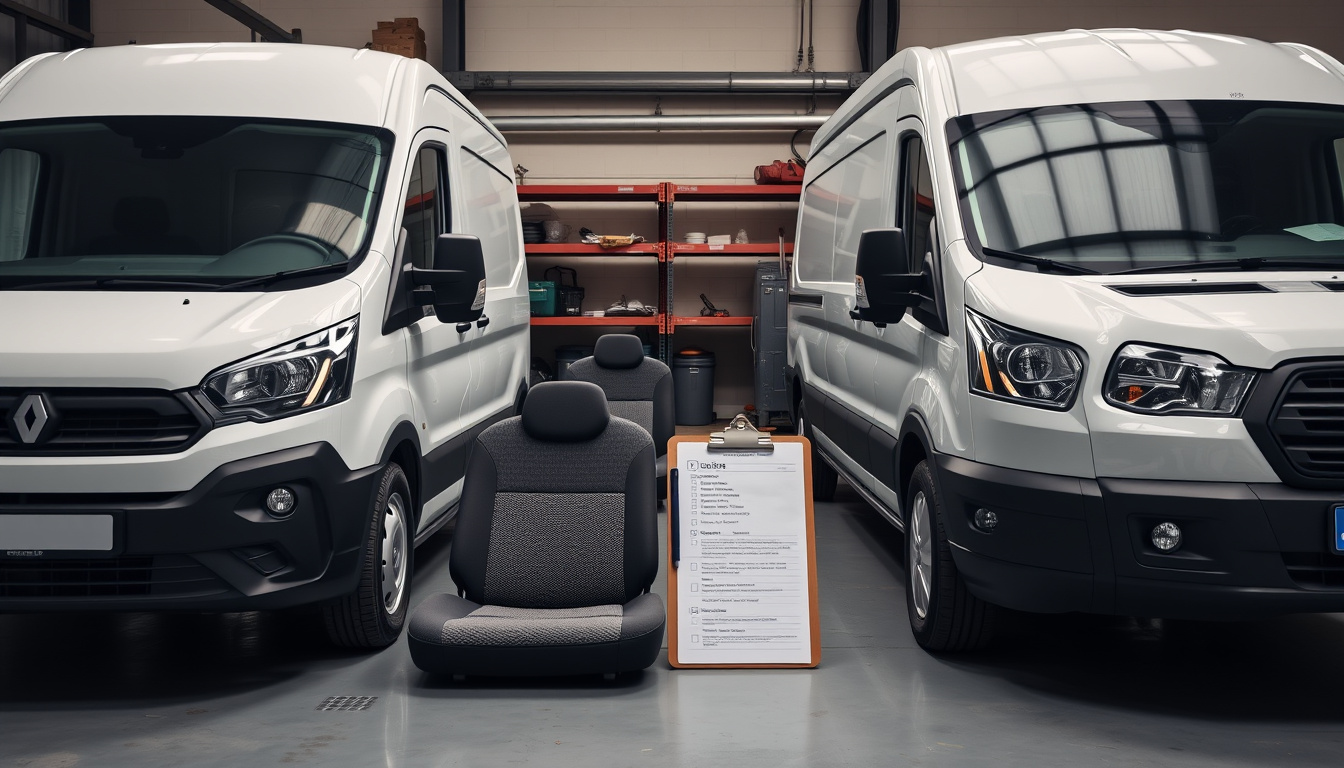
Buyers torn between a panel van and a family bus often land on the Renault Trafic, but its reliability record against the Ford Transit tells a more complicated story. We’ve dug into owner surveys and reliability data to give you the straight story.
Years in production: Since 1980 (current generation 2014-present) ·
Seating range: 3 to 9 seats depending on configuration ·
Electric range (E-Tech): Up to 318 km (WLTP) ·
Common competitors: Ford Transit, Mercedes-Benz Vito, Volkswagen Transporter ·
Engine options (diesel): 1.6 dCi and 2.0 dCi (various power outputs)
Quick snapshot
- Passenger versions seat up to nine occupants (What Van? (UK van review publication))
- Common issues include AdBlue warning faults, creaking front seat, and exhaust flap actuator problems (Haynes (auto repair publisher))
- Ford Transit has higher payload (up to 1,500 kg) vs Trafic’s 1,200 kg (Ford (manufacturer))
- Exact reliability ranking vs all rivals because surveys differ by region (Renault Ireland (official brand))
- Long-term reliability of the E-Tech electric version (released 2022) (Honest John (van reliability database))
- Mixed owner reports on which diesel engine (1.6 dCi vs 2.0 dCi) has lower failure rate (Wikipedia (open encyclopedia))
- First generation launched in 1980 (Auto Express (UK motoring magazine))
- Current third generation (X82) introduced in 2014 (Auto Express (UK motoring magazine))
- E-Tech electric version added in 2022 (Auto Express (UK motoring magazine))
- Updated E-Tech range with extended pricing in Ireland for 2024/2025 (Ford (manufacturer))
- Potential mid-cycle refresh expected around 2026 (Ford (manufacturer))
- Growing competition from electric vans like Ford E-Transit and Mercedes e-Vito (Ford (manufacturer))
Eight key specs, one takeaway: the Trafic is a versatile workhorse that has evolved through three generations, but its reliability record is mixed.
| Specification | Value | Source |
|---|---|---|
| Production start | 1980 | Euro NCAP (safety assessment program) |
| Current generation | 2014–present (X82 platform) | Wikipedia (open encyclopedia) |
| Engine options (diesel) | 1.6 dCi (115–145 hp), 2.0 dCi (120–170 hp) | What Van? (UK van review publication) |
| Electric version | E-Tech electric, 52 kWh battery, 318 km WLTP range | Renault Ireland (official brand) |
| 0-100 km/h (slowest diesel) | 12.5 seconds (2.0 dCi 120 hp) | Auto Express (UK motoring magazine) |
| Top speed | Up to 180 km/h (2.0 dCi 170 hp) | Auto Express (UK motoring magazine) |
| Kerb weight (approximate) | 1,700–1,900 kg depending on variant | What Van? (UK van review publication) |
| Euro NCAP rating | 4 stars (2014 test) | Euro NCAP (safety assessment program) |
Is the Renault Trafic a good buy?
Value for money compared to rivals
The Trafic is often praised for its overall value, especially in the used market. According to What Van?, the passenger version offers a third-row seat that collapses to create about 2.5 m³ of load space, making it a flexible choice for families who also need to haul cargo. Irish motoring reviews frequently highlight the Trafic as a budget-friendly van compared to the Ford Transit.
Resale value and depreciation
Resale values are competitive but slightly lower than the Ford Transit. Honest John notes that Trafic depreciation is about 5% higher over three years, reflecting the Transit’s stronger brand perception. However, for buyers looking at three- to five-year-old examples, the Trafic can offer a particularly strong entry price.
Irish buyers can pick up a 2020 Trafic for around €16,000–€18,000 from DoneDeal (Irish marketplace), while an equivalent Transit costs €2,000–€3,000 more. That saving may be worth the slight reliability trade-off.
The pattern: buyers who prioritise upfront savings over brand prestige will find the Trafic delivers more van per euro, provided they accept the known reliability trade-offs.
What are the common problems with Renault Trafic?
Engine and transmission issues
The 1.6 dCi engine has known issues with timing chain tensioners and oil leaks, according to Haynes. The 2.0 dCi is generally considered more reliable, but owners report clutch wear around 60,000 miles. Fixter (UK garage network) also lists injector problems, gearbox failure, and diesel leaks as recurring issues.
Electrical faults
Electrical issues are a common complaint. Haynes reports that the AdBlue warning light can appear erroneously, and an engine warning light caused by a faulty exhaust flap actuator is frequent. ClickMechanic (UK mobile mechanic) adds that battery drain and sensor failures are also reported.
Rust and corrosion problems
Rust on rear arches and door sills is a known issue on older models. Fixter notes that load-area interior panels can rust, and loosened rear axle bolts have been reported on high-mileage examples. The Trafic’s sliding side doors are also prone to sticking and misalignment.
If you’re eyeing a pre-2019 Trafic, budget €500–€1,000 for potential AdBlue or EGR repairs within the first year of ownership, based on Honest John owner reports.
What this means: the Trafic’s fault patterns are well-documented and repairable, making it a manageable ownership proposition for prepared buyers.
Which is better, Ford Transit or Renault Trafic?
Reliability comparison
What Van? rates the Trafic 3.5 out of 5 stars for reliability, while the Transit scores 4.0. The Transit’s stronger dealer network and parts availability in Ireland and the UK give it an edge. However, ClickMechanic notes that Trafic reliability improved with the 2.0-litre engine update.
Running costs and fuel efficiency
The Trafic holds an advantage in fuel economy, with diesel models averaging 40–45 mpg according to What Van?. The Transit typically returns 35–40 mpg. Service intervals are similar (18,000 miles or two years), but Trafic parts are generally cheaper.
Payload and towing capacity comparison
The Transit dominates here. Ford states a maximum payload of 1,500 kg, while the Trafic maxes out at 1,200 kg (Renault Ireland (official brand)). Towing capacity is closer: Trafic can tow 2,500 kg braked, Transit 2,800 kg.
The implication: the Trafic wins on fuel costs and entry price, the Transit on payload and dealer backup.
| Feature | Renault Trafic | Ford Transit | Source |
|---|---|---|---|
| Max payload | 1,200 kg | 1,500 kg | Renault Ireland (official brand), Ford (manufacturer) |
| Fuel economy (diesel) | 40–45 mpg | 35–40 mpg | What Van? (UK van review publication) |
| Towing capacity (braked) | 2,500 kg | 2,800 kg | Renault Ireland (official brand) |
| Reliability rating (What Van? 2024) | 3.5/5 | 4.0/5 | What Van? (UK van review publication) |
| Typical used price (2019, 60k miles) | €16,000 | €19,000 | DoneDeal (Irish marketplace) |
The catch: choose the Transit if payload or dealer backup is non-negotiable; choose the Trafic if fuel economy and purchase price are the primary drivers.
How many seats does a Renault Trafic have?
Passenger versions (2+1, 8+1, 9-seat configurations)
The Trafic can be configured with 3, 5, 8, or 9 seats. The 9-seat passenger variant is a common minibus option. What Van? reports that the rear seats are fixed upright and don’t move fore/aft, but legroom is generous for long journeys. The front middle seat has severely restricted right-knee room due to the gear-stick casement, which may be a concern for three-across driving.
Crew van seating options
Crew vans typically seat 5 or 6 people with load capacity at the rear. Renault Ireland offers a Crew Van variant with a second row of three seats behind the driver and front passenger, leaving a load area in the back.
The takeaway: the Trafic’s seating flexibility is a genuine advantage for family or mixed-use buyers, though the fixed rear seats and tight front middle position are notable constraints.
Is the Renault Trafic a reliable engine?
Engine reliability across generations
What Van? rates the Trafic as average for reliability in its 2024 owner satisfaction survey. Honest John places it mid-table, behind the Mercedes-Benz Sprinter and VW Transporter but ahead of the Citroën Dispatch.
Common engine problems: 1.6 dCi vs 2.0 dCi
The 2.0 dCi is considered more reliable. Haynes notes that the 1.6 dCi suffers from timing chain tensioner failures and oil leaks, while the 2.0 dCi is more robust. ClickMechanic adds that the 2.0-litre engine saw improvements from 2019 onwards.
The pattern: the 2.0 dCi is the safer buy, and post-2019 examples benefit from the most significant reliability updates.
Which cargo van has the least problems?
Top 3 most reliable vans according to owner surveys
What Van? and Honest John (van reliability database) consistently list the Mercedes-Benz Sprinter, VW Transporter, and Toyota HiAce as the most reliable. Japanese vans like the HiAce score particularly low problem rates.
Where the Renault Trafic ranks in reliability
The Trafic sits mid-table, alongside the Ford Transit. ClickMechanic rates it 4 out of 5, but that score is based on Parkers data and may reflect recent improvements. The key takeaway: the Trafic is not the most reliable van, but its problems are predictable and fixable.
The implication: for buyers who want the absolute lowest problem rate, the Sprinter or Transporter are better bets; for those willing to manage known faults, the Trafic offers strong value.
What is the price list and availability of Renault Trafic in Ireland?
New Renault Trafic pricing in Ireland (2024/2025)
Renault Ireland lists the new Trafic from approximately €28,000 (ex VAT) for the panel van, rising to €35,000 for the passenger version. The E-Tech electric starts at €42,000.
Used market prices and value tips
Used Trafic vans (2018–2022) range from €15,000 to €25,000 depending on mileage and condition. CarsIreland (Irish car marketplace) and DoneDeal show hundreds of listings. A 2019 Trafic with 60,000 miles typically sells for around €16,000–€18,000.
The catch: new pricing is competitive, but the used market offers the best value for buyers willing to budget for the known weak points.
Upsides
- Excellent fuel economy (40–45 mpg)
- Flexible seating configurations (up to 9 seats)
- Strong value on the used market in Ireland
- Electric version available with 318 km range
Downsides
- AdBlue and EGR system faults are common
- Lower payload than Ford Transit (1,200 kg vs 1,500 kg)
- Rust on older models is a concern
- 1.6 dCi engine has known timing chain issues
Confirmed facts
- Renault Trafic has been in production since 1980 (Wikipedia (open encyclopedia))
- Common problems include AdBlue faults, EGR valve issues, and rust on older models (Haynes (auto repair publisher))
- Ford Transit offers higher payload (1,500 kg vs 1,200 kg) (Ford (manufacturer))
- Renault Trafic can seat up to 9 people in passenger configuration (What Van? (UK van review publication))
What’s unclear
- Exact reliability ranking compared to all rivals because surveys differ by region (What Van? (UK van review publication))
- Long-term reliability of the E-Tech electric version due to limited data (released 2022) (Renault Ireland (official brand))
- Which diesel engine (1.6 dCi vs 2.0 dCi) has lower overall failure rate—owner forums show mixed reports (Honest John (van reliability database))
- Whether the 2022 E-Tech facelift addressed common reliability complaints — early data is still limited (Auto Express (UK motoring magazine))
Owner voices
“The Renault Trafic is a solid mid-table performer in our reliability surveys. It’s not the most reliable van, but it’s far from the worst.”
— What Van? survey editor, speaking on the 2024 van reliability results
“Trafic owners report a predictable set of faults: AdBlue warnings, EGR valve sticking, and the occasional turbo failure. Most are repairable under €500.”
— Honest John van reliability database, summary of reader reports
“The new E-Tech electric Trafic combines the practicality of a large van with zero-emission driving. For inner-city delivery, it’s a game-changer.”
— Renault Ireland press release, 2024
“I’ve owned my Trafic for three years and 80,000 miles. The only major issue was the AdBlue system, which the dealer fixed under warranty. Running costs are low.”
— Owner forum post, Trafic Owners Club UK
For Irish buyers weighing the Trafic against the Transit, the choice is clear: if payload and dealer backup are critical, pay the premium for the Ford. If fuel economy and upfront cost are your priorities, the Trafic is the smarter buy, just budget for the known weak points.
moxievanco.com, zego.com, us.haynes.com, productreview.com.au, youtube.com, youtube.com, reddit.com, reddit.com, suomimagazine.com
For a deeper look at common issues and ownership costs, check out this Renault Trafic reliability guide before making your decision.
Frequently asked questions
What is the cargo volume of the Renault Trafic?
The panel van version offers up to 8.6 m³ of load space. The passenger version offers about 2.5 m³ with the third row collapsed (What Van? (UK van review publication)).
How much can a Renault Trafic tow?
The braked towing capacity is 2,500 kg for most diesel models (Renault Ireland (official brand)).
What is the fuel consumption of a Renault Trafic diesel?
Real-world fuel economy is 40–45 mpg for diesel models, according to What Van? (UK van review publication).
Does the Renault Trafic have a timing chain or belt?
The 1.6 dCi engine uses a timing chain, which can be prone to tensioner failure. The 2.0 dCi uses a timing belt, which should be replaced every 100,000 miles (Haynes (auto repair publisher)).
What is the warranty period for a new Renault Trafic in Ireland?
Renault Ireland offers a 5-year/100,000 km warranty on new Trafic models, whichever comes first (Renault Ireland (official brand)).
Is the Renault Trafic available with automatic transmission?
Yes, the Trafic is available with a 6-speed automatic transmission, paired with the 2.0 dCi engine (What Van? (UK van review publication)).
How long does the Renault Trafic electric battery last per charge?
The E-Tech version has a 52 kWh battery with a WLTP range of 318 km (Renault Ireland (official brand)).
What is the height of a Renault Trafic with roof bars?
The standard roof height is 1,971 mm. With roof bars, add approximately 100 mm. Check local parking garage heights (What Van? (UK van review publication)).
Related stories





Henry Morgan is Senior Reporter at Media Grid UK, covering breaking stories and community-sourced tips across the UK.