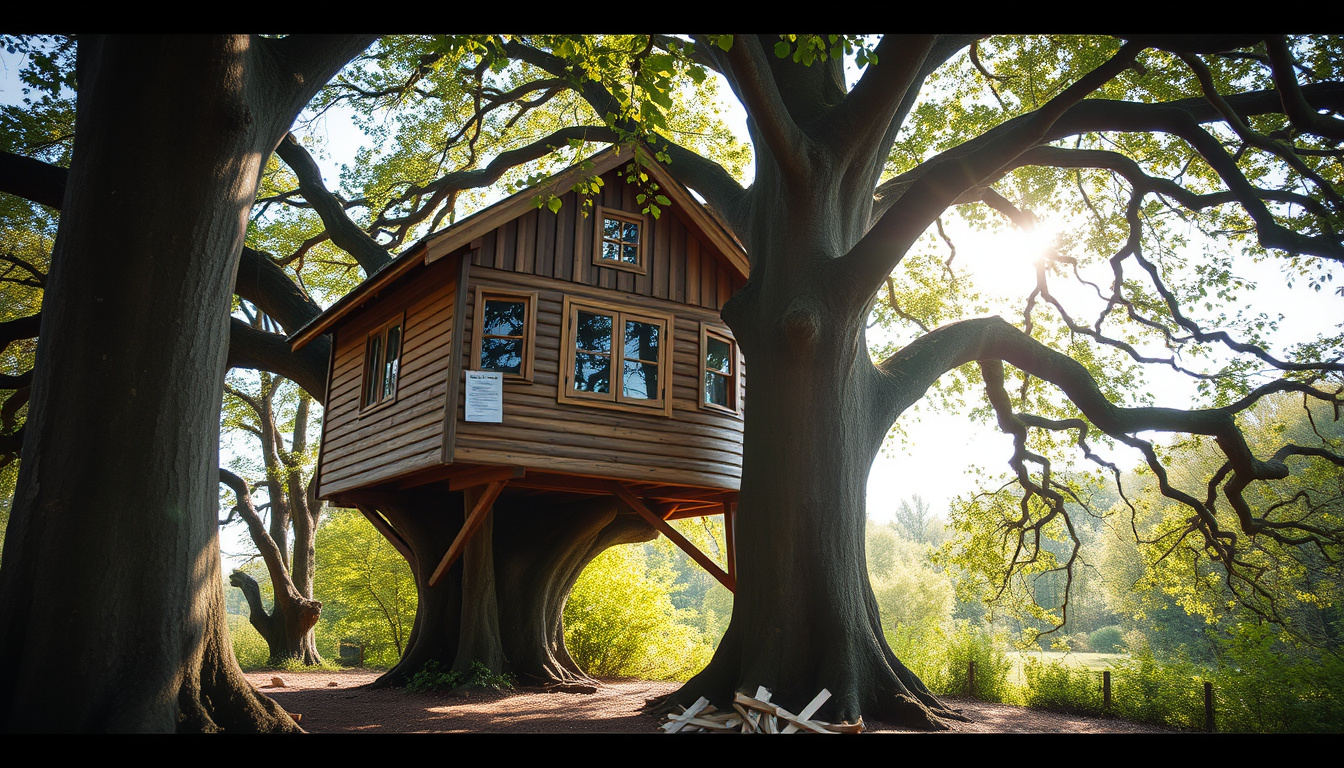
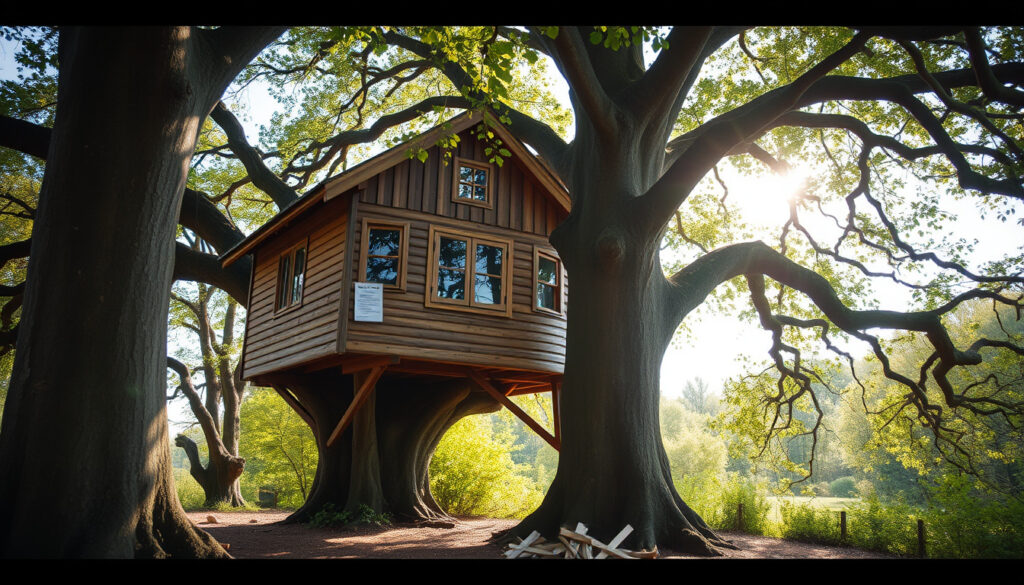
There’s something about a tree house that makes even adults look up with a hint of nostalgia. Whether you’re planning a play den for the kids or a quiet garden escape, this guide walks through the regulations, costs, and tree choices that actually matter for first-time builders.
Average lifespan of a well-maintained treehouse: 15–30 years ·
Typical cost range for a small treehouse: $1,500–$10,000 ·
Most common wood used: Pressure-treated pine or cedar ·
UK planning permission requirement (most small structures): Not required under 2.5 metres ·
Average build time for a DIY treehouse: 3–7 days
Quick snapshot
- Most small treehouses under 2.5m height do not need planning permission (Treetop Co., UK treehouse builder)
- Oak, maple, fir, and beech are strong preferred species (Enchanted Forest Treehouse, specialist guide)
- Well-maintained treehouses last 15–30 years (industry consensus) (Treetop Co., UK treehouse builder)
- Exact cost of treehouse insurance varies by location and build quality
- Impact of tree growth on structural fasteners over decades is not well studied
- Well-maintained treehouses last 15–30 years (no source)
- 2008: First treehouse hotel in the UK opens (Living Architecture)
- Planning applications should allow at least 8 weeks for processing (Squirrel Design Treehouses, UK builder)
- Prefab treehouse kits expected to grow in popularity (Squirrel Design Treehouses, UK builder)
Planning rules and costs vary by location, but these key facts give a baseline.
| Fact | Detail |
|---|---|
| Planning permission threshold (height) | Under 2.5m generally exempt; over 4m likely required (Irwin Mitchell, UK law firm) |
| Planning permission threshold (garden coverage) | Must not cover more than half of the garden (Treetop Co.) |
| DIY build cost (basic) | £1,200–£4,000 (materials only) (Checkatrade, UK trades platform) |
| Professional build cost (medium) | £8,000–£25,000 (The Treehouse Shop, UK retailer) |
| Luxury treehouse cost | £30,000–£60,000+ (High Life Treehouses, UK builder) |
| Average build time (professional) | 1–6 months, plus 8 weeks for planning if needed (Squirrel Design Treehouses) |
| Lifespan with maintenance | 15–30 years (industry standard) |
| Best tree species (UK) | Oak, maple, fir, beech, cedar, Douglas fir (Enchanted Forest Treehouse guide) |
What Are Treehouses?
Treehouses are elevated structures built among tree branches. They can be simple platforms or multi-room dwellings, and they’re used for play, relaxation, or even accommodation. The concept is straightforward: a platform anchored to one or more trees, with walls and a roof.
Key features of a treehouse
- Elevated platform typically 2–5 metres off the ground
- Supported by bolts, brackets, or posts (sometimes independent of the tree)
- Standard platform size around 8ft × 8ft (2.4m × 2.4m) (R Design Treehouses, UK builder)
Common uses for treehouses
- Children’s playhouse
- Garden office or studio
- Guest accommodation
- Luxury rental (e.g., treehouse hotels)
The implication: a treehouse is more versatile than many assume — it can be a simple weekend project or a serious architectural investment.
Do You Need Planning Permission for a Treehouse in the UK?
This is the first question most UK builders ask. The short answer: it depends on size and location.
When planning permission is required
Under UK rules, a treehouse is treated as a structure. If it exceeds 4 metres in height or covers more than half of the garden, planning permission is needed (The Treehouse Shop, UK retailer).
Exceptions under permitted development
Small treehouses under 2.5 metres height and within garden coverage limits often qualify as permitted development. But if your property is listed or in a conservation area, additional consent may be required (Irwin Mitchell, UK law firm).
The 2.5 metre rule explained
The 2.5m rule is a common benchmark: any structure within 2 metres of a boundary must not exceed 2.5 metres in height. Treehouses further from the boundary have more leeway. Always check with your local council before building.
A listed property may require listed building consent even for a small treehouse — ignoring this can lead to enforcement action (Irwin Mitchell).
What this means: for most standard back-garden treehouses, permission isn’t needed — but the corner cases (listed buildings, conservation areas, tall structures) demand a call to the council.
How Much Does It Cost to Build a Treehouse?
Costs vary enormously based on size, materials, and whether you DIY or hire a pro.
Cost breakdown for a simple treehouse
- DIY (materials only): £1,200–£4,000 (Checkatrade, UK trades platform)
- Professional basic build: £8,000–£15,000 (The Treehouse Shop, UK retailer)
- Medium professional build: £15,000–£25,000 (R Design Treehouses, UK builder)
Cost factors: design, materials, labour
| Factor | Impact on cost |
|---|---|
| Materials (wood, bolts, roof) | 40–60% of total cost |
| Labour (professional builder) | 30–40% |
| Design complexity (multi-room, insulation) | Adds 20–50% |
| Location access (difficult garden) | Can add 10–30% (High Life Treehouses, UK builder) |
Budgeting for luxury treehouses
Luxury builds with electricity, plumbing, and hot tubs can exceed £60,000. R Design Treehouses quotes from £20,000 + VAT (R Design Treehouses). The Gardens RHS guide notes that high-end garden structures require professional project management.
The trade-off: going DIY saves labour but demands time and skill. Professional builds cost more but include structural guarantees and faster completion.
What’s the Best Tree for a Tree House?
Choosing the right tree is critical for safety and longevity.
Ideal tree species and characteristics
- Oak: extremely strong, long-lived
- Maple: hard wood, good branch structure
- Fir / Douglas fir: straight trunk, strong
- Beech: solid, broad canopy
- Cedar: rot-resistant, light (Enchanted Forest Treehouse guide)
Signs of a healthy tree for building
Look for a trunk diameter of at least 30cm (12 inches) at build height. The bark should be intact, no signs of fungal growth or decay. Branches should be robust and well-spaced.
How to avoid damaging the tree
Use dynamic bolts that allow movement. Never girdle the trunk. An arborist consultation can prevent long-term harm.
Tree that looks healthy today may weaken in 10–20 years. A post on the Treehouse Builders Facebook group notes that tree strength may require decades of growth before supporting a structure.
Why this matters: a poor tree choice can turn a dream treehouse into a hazard. Investing in a professional tree health check is cheap insurance.
What Is the Lifespan of a Treehouse?
A well-built treehouse can last 15 to 30 years, but maintenance is key.
Factors affecting lifespan
- Wood type and treatment
- Weather exposure (rain, UV)
- Tree growth causing stress on attachments
- Quality of initial construction
Maintenance schedule for long life
Re-seal wood every 2–3 years. Check bolts and brackets annually for loosening. Inspect the tree for disease or structural change. A health warning sign analogy: just like you monitor chest pain, monitor your treehouse tree for cracks and leaning.
When to replace or repair a treehouse
If the platform becomes uneven, roof leaks persist, or wood shows rot – it’s time for repairs. After 15 years, major structural assessment recommended.
The pattern: treehouses don’t fail overnight – they give gradual warnings. A yearly 30-minute check prevents costly rebuilds.
Is It Easy to Build a Treehouse?
It depends on your DIY skill level. A basic platform with ladder is achievable for a confident DIYer; a multi-room treehouse demands more.
Skill level required
- Intermediate carpentry (measuring, sawing, drilling)
- Ability to level a structure
- Comfort working at height
Recommended tools and safety gear
- Circular saw, drill, level, ladder
- Safety harness (when working above 2m)
- Gloves, goggles
Step-by-step build overview
- Choose and inspect tree
- Design platform and obtain materials
- Build platform structure on ground (if possible)
- Hoist and secure platform using tree bolts
- Add walls, roof, and ladder
- Finish with sealing and safety checks
A DIY treehouse may take 1 to 6 months depending on complexity (The Treehouse Shop).
First-time builders should start with a small platform. Professional build time is 3–7 days; DIY takes longer but can be rewarding.
Popular Tree House Options in Ireland
Ireland has a growing market for treehouses, from playhouses to luxury retreats.
Tree houses for kids in Ireland
Several Irish companies sell prefabricated treehouses for children, with prices from €1,500 for basic kits.
Luxury tree houses for adults
Luxury treehouses with hot tubs are available for rent across Ireland, including in Wicklow and Kerry.
Where to buy tree houses in Ireland
Companies like Irish Treehouse Co. and Garden Structures Ireland offer bespoke builds and kits. Tree houses for sale exist as permanent garden structures.
Why this matters: Ireland’s planning rules differ slightly from the UK – always consult your local county council before buying or building.
These specifications summarise common treehouse dimensions.
| Specification | Value |
|---|---|
| Treehouse typical height | 2–5 metres off ground |
| Common build time | 3 days to 2 weeks |
| Standard platform size | 8ft x 8ft (2.4m x 2.4m) |
| Maximum recommended occupancy | 4–6 people depending on size |
| Average lifespan | 15–30 years |
| DIY cost (materials only) | £1,200–£4,000 |
| Professional cost (medium) | £8,000–£25,000 |
| Planning permission threshold | Under 2.5m height exempt |
| Tree diameter requirement | At least 30cm at build height |
Upsides
- Adds unique garden feature
- Increases property appeal
- Can be built relatively cheaply DIY
- Flexible design options
Downsides
- Requires ongoing maintenance
- Tree health can limit lifespan
- Planning permission can be tricky
- Professional builds are expensive
Timeline: Evolution of the Treehouse
- : Treehouses popularized as children’s play structures in suburban backyards
- : Luxury treehouse rentals emerge as niche accommodation
- : First treehouse hotel in UK opens (Living Architecture)
- : Rise in DIY treehouse kits and online guides
What’s Confirmed vs. What’s Unclear
Confirmed facts
- Treehouses under 2.5m typically do not need planning permission in the UK (Treetop Co.)
- Oak, maple, and fir are suitable tree species (Enchanted Forest Treehouse)
- Average cost for a basic treehouse is £2,000–£5,000 (Checkatrade)
What’s unclear
- Exact cost of treehouse insurance varies by location and build quality
- Impact of tree growth on structural fasteners over decades is not well studied
- Effect of climate change on UK tree species suitability for treehouses
- Well-maintained treehouses last 15–30 years is an industry consensus but lacks a specific source
Expert Perspectives
“Small treehouses in domestic gardens usually do not need a formal building application, but if you’re in a conservation area or have a listed building, you must check first.”
— UK planning expert at Irwin Mitchell
“Select a mature tree with a solid trunk and good branch structure. Avoid any tree showing signs of disease or rot.”
— Arborist writing for Enchanted Forest Treehouse guide
Building a treehouse in the UK or Ireland is an achievable project, but the difference between a safe, lasting structure and a costly mistake comes down to planning permission checks, tree selection, and realistic cost planning. For first-time builders in the UK, the choice is clear: start small, verify your local council’s rules, and invest in a healthy, mature tree — or face repairs and regrets within a decade.
mperryassociates.com, thetreehouseguys.com, treehouseguides.com, riksarena.se
Frequently asked questions
Can you put a treehouse in a tree that is already used for garden?
Yes, but ensure the tree is healthy and not overcrowded with other structures.
How do I anchor a treehouse without damaging the tree?
Use dynamic bolts that allow movement and prevent girdling. Consult an arborist.
What type of wood is best for a treehouse floor?
Pressure-treated pine or cedar are durable and rot-resistant.
Do treehouses attract pests or wildlife?
They can, but proper sealing and regular inspection minimize issues.
Can a treehouse be moved to another tree?
Generally not – they are built to fit the specific tree. A modular design may allow partial relocation.
Is treehouse insurance required in the UK?
Not legally, but home insurance may need updating to cover the structure.
What height should a treehouse be off the ground?
Typically 2–3 metres for safety and tree health.
How many trees do you need to support a treehouse?
At least two for stability, but some designs use three or more.
Related stories





Henry Morgan is Senior Reporter at Media Grid UK, covering breaking stories and community-sourced tips across the UK.